
When a Bespoke ERP System Makes Sense
Enterprise resource planning software promises to run the whole business from one system, covering finance, stock, purchasing, jobs and people. For many organisations a packaged ERP does that job well. For others, particularly construction firms, shipping and logistics operators and manufacturers with unusual processes, the packaged product becomes something the business works around rather than with and that’s where custom ERP development through Priority Pixels’ web application development for B2B organisations starts to make sense.
A bespoke ERP doesn’t have to mean replacing everything at once. In most cases the most practical route keeps the finance software you already trust and builds the operational system around it, one module at a time.
What an ERP System Does
An ERP brings the core records of a business into one shared system, so jobs, orders, stock, purchasing and finance all refer to the same data. The aim is that a sales order can become a job, a purchase order and an invoice without anyone retyping the details. When it works, managers can see margins, capacity and cash in one place.
Large packaged ERPs cover a wide range of industries through configuration and they’re built around the processes most businesses share. The difficulty comes when your processes are the part that makes you different, because configuring a generic product to match them can cost more and deliver less than expected.
Signs a Packaged ERP No Longer Fits
Most businesses don’t decide to build a bespoke ERP in a single moment. The case builds gradually as workarounds pile up around the existing system and the warning signs look similar across sectors.
Look for these patterns in your own operation and note how much staff time each one consumes. Several of them together usually mean the system is costing more in lost hours than its licence suggests.
- Key processes run in spreadsheets alongside the ERP because it can’t handle them
- Staff retype the same information into the ERP, the CRM and the finance system
- Customisations have made upgrades so risky that the system is several versions behind
- Licence costs rise with headcount while many users only need a single screen
- Reports need exporting and reworking before managers can use them
- Customers and suppliers still get updates by phone and email because the system can’t share data with them
Construction firms often see these symptoms around job costing and subcontractor management, where estimating, procurement, project management and accounts software each hold part of the picture, which is why software for construction companies so often centres on joining those records up. Shipping and logistics operators see them around fleet, cargo and port data that general purpose ERPs weren’t designed around and manufacturers see them in scheduling rules specific to their products.
When Custom ERP Development Makes Sense
A bespoke ERP is worth considering when your core processes are distinctive, when those processes drive your margins and when the cost of working around a packaged system is clearly higher than the cost of building. It rarely makes sense for standardised functions such as payroll or statutory accounting, where packaged software is mature and regulatory changes are handled for you. The GOV.UK guidance on choosing technology encourages mapping which components to build and which to buy and that discipline suits ERP decisions well.
The decision should rest on evidence rather than frustration. The GOV.UK Service Manual describes a discovery phase that focuses on understanding users and the problem before committing to build anything. Priority Pixels opens every software project with two structured discovery calls, walking through the process as your team runs it, including the exceptions and workarounds that have built up over years.
System changes succeed or fail on people as much as technology. Harvard Business Review’s argument that digital transformation is not about technology applies directly to ERP projects, where the hardest work is usually agreeing how processes should run.
Building Around Your Existing Finance Software
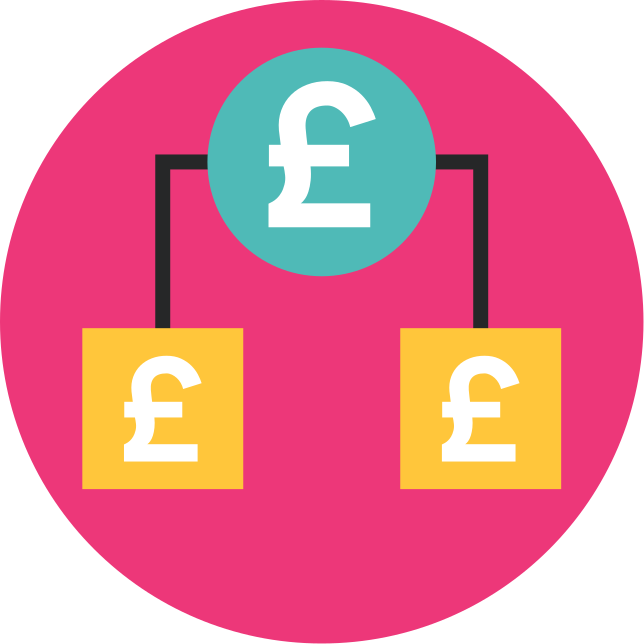
Few businesses want to move their accounts to a new system and there’s rarely a good reason to. Packaged finance software such as Xero, QuickBooks or Sage is mature, handles tax and statutory reporting and is already familiar to your accountants. A bespoke ERP can treat the finance package as the ledger and build the operational layer around it.
In practice, jobs, orders and purchasing live in the bespoke system, while invoices, payments and reconciliation flow to the finance package through its API. Every data flow is documented before build, covering what moves, in which direction and what happens if a transfer fails. Priority Pixels builds these connections as part of its systems integration work and older systems without an API can still take part through scheduled exports or database views.
Keeping the finance data where it is also limits risk. Your year end, audit trail and accountant’s access stay unchanged and the bespoke system only moves the fields each job needs, in line with the UK GDPR data minimisation principle wherever personal data is involved.
Connecting ERP to Your CRM and Customer Portals
An ERP becomes far more useful when it shares data outward. Connecting it to your CRM means a won deal becomes a job without rekeying and account managers can see order status, delivery dates and outstanding invoices without asking operations. The same records can feed a customer portal, so clients see progress, documents and invoices through their own login.
Most bespoke ERP projects end up connecting to three groups of system. Each connection should be planned during discovery, even if it’s built in a later phase.
CRM
Won opportunities create jobs and orders automatically. Account managers see live order and invoice status against each customer.
Customer portal
Clients log in to see project progress, documents and invoices. Stage approvals can happen in the portal rather than by email.
Reporting
Margins, capacity and cash appear in one live view. Threshold alerts flag jobs drifting off budget before month end.
Planning these connections early keeps the data model consistent. It’s far easier to design customer and job records that serve the CRM, the portal and your reporting dashboards from the outset than to reshape them after launch.
Delivering a Bespoke ERP in Phases
The most reliable way to deliver a bespoke ERP is one module at a time. Each phase replaces a specific spreadsheet or workaround, goes live alongside existing systems and proves itself before the next begins. That approach spreads the investment, reduces disruption and lets your team shape later phases based on what they’ve learned from earlier ones.
Costs depend on the number of modules, the complexity of your business rules and the number of systems each module connects to, so phasing also gives you clear decision points. A typical roadmap follows the pattern below, though the order of modules should follow wherever the business feels the most pain.
Phased delivery
A Typical Bespoke ERP Roadmap
One module at a time
- Discovery and written scope
- Core job and order records
- Finance system integration
- CRM connection
- Customer portal
- Reporting and dashboards
Priority Pixels delivers each phase against a written scope with acceptance criteria and a price fixed after discovery and every launch has rollback available. If your current ERP has become something your team works around, a discovery conversation is a practical way to find out whether a bespoke ERP, better integration or a different packaged product is the right answer.
FAQs
What is a bespoke ERP?
A bespoke ERP is a business management system built around one organisation’s own processes for jobs, orders, stock and purchasing. It usually connects to existing finance software rather than replacing it.
Do we need to replace our accounting software to build a bespoke ERP?
In most cases you can keep your existing finance package, such as Xero, QuickBooks or Sage. The bespoke system handles operations and passes invoices and payments to the finance software through its API.
Can a bespoke ERP be delivered in stages?
Phased delivery is usually the most practical approach, with each module replacing a specific workaround before the next begins. It spreads the investment and lets your team shape later phases based on experience.

Co-Founder at Priority Pixels
Paul leads on development and technical SEO at Priority Pixels, bringing over 20 years of experience in web and IT. He specialises in building fast, scalable WordPress websites and shaping SEO strategies that deliver long-term results. He’s also a driving force behind the agency’s push into accessibility and AI-driven optimisation.

 Nathan Yendle | 02/10/2026