






Choosing an Ecommerce PPC Agency: What to Look For

An ecommerce PPC agency plans and manages paid search and shopping campaigns for online retailers, built around product feeds and revenue rather than keyword lists and enquiry forms. Choosing the right one matters because the quality of your feed, campaign structure and tracking decides how much of your ad spend turns into profitable orders. If you are comparing providers of PPC management for ecommerce businesses, the points below set out what a capable agency should offer and how to test it.
Ecommerce PPC services cover Google Shopping, Performance Max, Microsoft Shopping and paid social for retailers and they call for a different skill set from lead generation campaigns. That applies to UK online retailers of every size, including WooCommerce stores, where product data, margins and stock change constantly.
What to Look For in an Ecommerce PPC Agency
A good ecommerce PPC agency should be able to show you seven things before you commit any budget. Use the list below as a shortlist filter, then test each agency against the detail in the sections that follow.
- A product feed audit covering titles, attributes, categories and Merchant Center errors.
- Experience running Google Shopping, Performance Max and Microsoft Shopping.
- An account structure based on margin, product performance and stock.
- Accurate conversion tracking with order values, set up to respect cookie consent.
- Reporting that shows profit as well as ROAS, revenue and average order value.
- Transparency, with the ad accounts, data and feed owned by your business.
- A clear working rhythm of updates, reviews and named contacts.
Most agencies will say yes to every point in a sales meeting. The difference shows when you ask how they would handle each one using your own products and margins.
How Ecommerce PPC Differs From General PPC
Ecommerce PPC differs from general PPC because product data, not keywords, drives most of the campaigns. Google’s documentation explains that before you can run Shopping ads, your products must be submitted to Google Merchant Center and that account linked to Google Ads. From that point, the feed decides which searches your products can appear for and what shoppers see in the ad.
A lead generation account might run a few dozen keywords and measure form submissions. An online store may have thousands of products, each with its own price, margin, stock level and seasonal demand, so ask any agency how many retail accounts it manages and what catalogue sizes it handles.
WooCommerce retailers have an extra consideration, because the feed usually comes from the store itself through a plugin or integration. Our article on choosing a PPC agency for a WooCommerce store covers that set-up and Priority Pixels provides Google Shopping expertise for ecommerce clients through WooCommerce integration.
The Ecommerce PPC Services a Good Agency Should Provide
The core ecommerce PPC services are feed management, Google Shopping, Performance Max, Microsoft Shopping and remarketing, with paid social added where your products suit it. The table below sets out what each involves and what good delivery looks like, so you can compare proposals on equal terms.
| Service | What it covers | What good looks like |
|---|---|---|
| Product feed and Merchant Center | Titles, descriptions, categories, images, price and availability | Regular audits, quick error fixes and search-led titles |
| Google Shopping | Product ads in Google search results and the Shopping tab | Product groups split by performance and margin |
| Performance Max | One campaign across Search, Shopping, YouTube, Display, Discover, Gmail and Maps | Asset groups and audience signals planned by product range |
| Microsoft Shopping | Product ads across Bing and the Microsoft Advertising network | Feed and bids managed for the platform, not simply copied from Google |
| Remarketing | Ads for people who viewed products or left the basket | Product-level ads, sensible frequency and exclusions for recent buyers |
| Meta ads for ecommerce | Catalogue and shopping campaigns on Facebook and Instagram | Catalogue retargeting and prospecting judged on ROAS by product set |
Google introduced Performance Max as a way to buy ads across YouTube, Display, Search, Discover, Gmail and Maps from a single campaign and it replaced Smart Shopping for retailers. It relies on the feed, assets and audience signals you give it, so an agency’s feed and tracking work shapes the results. Priority Pixels is a Google Partner and its Google Ads team holds certification across Search, Display, Video and Shopping, which covers the campaign types most retailers use.
Microsoft’s overview of Microsoft Shopping campaigns describes product ads with images, pricing, ratings and promotions and existing Google Shopping campaigns can be imported. Our Microsoft Ads management covers feed set-up, bids and product performance monitoring. For visually led ranges, our Meta Ads management includes Advantage+ sales campaigns, which Meta previously called Advantage+ Shopping and catalogue campaigns for ecommerce clients.
How an Agency Should Handle Your Product Feed
A capable agency starts with a feed audit, because every Shopping and Performance Max campaign draws on the same product data. Missing attributes, vague titles, wrong categories and price or stock mismatches with the website all limit where products can appear. Feed work is one of the first things to check when choosing a Google Shopping agency.
Titles deserve particular attention, since they play a large part in matching products to searches. A title that names the brand, product type and attributes people search for, such as size, colour or material, gives the product a far better chance than a manufacturer code. For Shopping campaigns, Priority Pixels optimises product titles and descriptions in Google Merchant Center to improve how often products appear and get clicked.
Feed work never stops, because new lines, price changes and seasonal ranges keep arriving. Ask how often the agency reviews the feed and who fixes Merchant Center errors. On WooCommerce, feed quality often depends on how product data is set up in the store, which is where bespoke WooCommerce development and PPC management benefit from working together.
Account Structure Built Around Margin and Product Performance
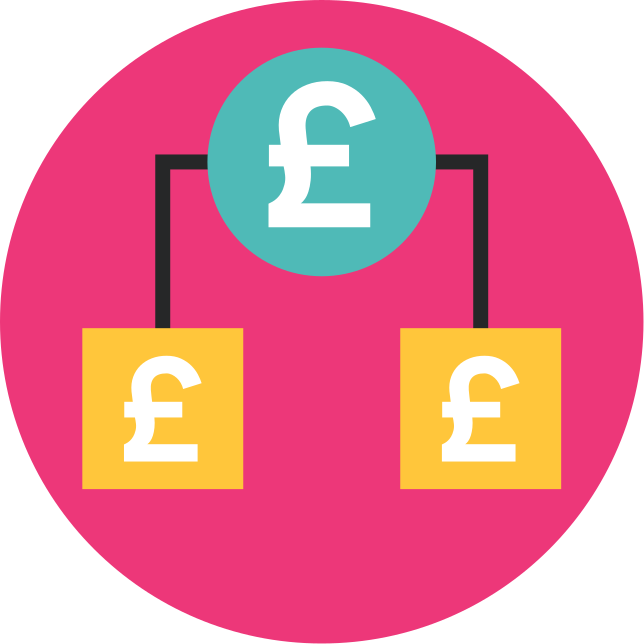
Account structure quickly shows whether an agency understands ecommerce, because it decides how much control you have over the budget. A single campaign containing every product treats a high-margin bestseller the same as a clearance line, which makes it very hard to protect profit.
A better approach groups products by what matters commercially, such as margin band, bestselling status, seasonality or stock depth. Custom labels in Merchant Center let an agency tag products this way and build campaigns or product groups around those tags, so high-margin lines can be given more room while low-margin or slow-moving products are held to stricter targets. Brand, generic and competitor searches also need separate treatment, because each behaves differently.
Budgets should move with demand. Seasonal ranges need more spend when they sell and less afterwards and new products need a test budget before anyone decides to scale them. Our article on building ecommerce PPC campaigns that drive revenue goes further into structure and bidding.
Stock levels need the same attention. Advertising a product that has sold out wastes clicks and disappoints shoppers, so the feed must report availability accurately and in step with the website. Google asks retailers to use the availability attribute to mark items as in stock, out of stock, preorder or backorder and to pause a product that is temporarily unavailable rather than delete it. A good agency will also ease off bids on lines running low and push harder when fresh stock arrives, so ask how its process links to your stock system.
Tracking, Consent and Profit-Based Reporting
Reliable measurement underpins every other decision, so an ecommerce PPC agency should check your tracking before it changes a single bid. Purchases need recording with their order value, duplicates removed and figures reconciled across Google Ads, Microsoft Advertising and GA4.
Consent has to be handled properly too. The ICO’s guidance on cookies and similar technologies says you must tell people about cookies and get their consent, with an exception for cookies that are strictly necessary for a service the user has asked for, such as remembering what is in their basket. Google’s consent mode passes each visitor’s consent choice to Google tags so they adjust their behaviour and support conversion modelling and an agency should know how it is set up on your store.
Reporting should then show whether the spend is profitable, not only whether it produces revenue. ROAS divides revenue by ad spend, so a campaign can report a healthy ROAS while selling low-margin products or items that are often returned. Profit-based reporting, or margin data fed into the conversion values used for bidding, gives a clearer view. For ecommerce clients Priority Pixels measures ROAS, revenue and average order value and our guide to ecommerce conversion rate benchmarks helps put website performance into context.
It also helps to separate new customers from returning ones. A first order from a new customer often costs more to win but can lead to repeat purchases, while someone who already buys from you may have ordered anyway. Google’s customer lifecycle goals let campaigns bid more for new or lapsed customers and they depend on accurate customer data to tell the groups apart. Ask any agency how it would reflect the value of repeat buyers in bidding and reporting, because judging campaigns on single orders undervalues those that bring in loyal customers.
Transparency and Account Ownership
Transparency means you can see what the agency is doing, why and what it is spending, at any point. You should have access to the ad accounts, search term reports, change history and feed, not just a monthly summary.
Account ownership matters just as much. Your Google Ads, Microsoft Advertising and Merchant Center accounts, along with GA4 and Google Tag Manager, should be created under your business with the agency given access through its manager account. If an agency builds everything in accounts it controls, your history and data can be hard to recover when the relationship ends.
Before signing, confirm in writing that your business holds admin access to every advertising, analytics and feed account. Agreeing this at the start avoids a difficult conversation later.
Performance Max raises a further transparency question, because it gives less channel and search term detail than a standard Shopping campaign. A good agency will explain which reports it uses to understand Performance Max results and how it compares them with Shopping before moving budget.
Red Flags When Comparing Agencies
Some warning signs appear early in the sales process and are worth taking seriously. The cards below cover those that most often lead to wasted spend or a difficult exit.
Agency-owned accounts
The agency wants to run your campaigns in accounts it owns. Leaving later can mean losing your account history and data.
Clicks over revenue
Reports lead with impressions, clicks and click-through rate. Revenue, ROAS and profit are hard to find or missing.
No feed audit
The proposal says little about your product data. Campaigns are planned before anyone has checked the feed.
Long lock-in
A long minimum term comes with no clear review points. A confident agency agrees a reasonable notice period.
Guaranteed returns are another warning sign, since no agency controls auction prices, competitors or seasonal demand. A credible agency talks about targets and how progress will be measured instead.
Questions to Ask Before You Sign
The most useful questions ask the agency to explain its approach on your account rather than describe its services in general. Answers should be specific and a capable agency will happily show example reports and account structures.
- How would you audit our product feed and how often will you review it?
- How would you structure our campaigns around margin and product performance?
- How do you decide between Shopping and Performance Max for our range?
- Do you manage Microsoft Shopping and Meta catalogue campaigns too?
- How will you check our conversion tracking and consent set-up?
- Will you report on profit as well as ROAS and revenue?
- Who owns the ad accounts, feed and data if we part ways?
- What are the contract length and notice period?
Asking for references from current ecommerce clients is also reasonable. If you already have an agency and want to judge it, our article on what to review in ecommerce PPC management covers the same ground from the other side.
What the Working Relationship Should Look Like

A good relationship with an ecommerce PPC agency is built on regular contact, shared data and planning around your trading calendar. You should know who manages your account, how often you will hear from them and how quickly they respond to changes in stock, pricing or promotions.
Planning matters most around Black Friday and Christmas, when feeds, budgets and creative need to be ready before demand rises. Tell the agency about promotions, new ranges and stock problems early, because campaigns can only reflect what it knows. Our practical guide to Google Shopping ads shows how those changes feed through to your product listings.
Our paid media retainer clients have live access to our reporting dashboard, the same view the team works from every day and our Google Ads management includes weekly updates and monthly reporting. Whichever agency you choose, that level of visibility is worth insisting on, because it lets you judge the work on evidence at any time.
FAQs
What does an ecommerce PPC agency do?
An ecommerce PPC agency plans and manages paid campaigns for online retailers, including product feeds, Google Shopping, Performance Max, Microsoft Shopping and remarketing. Its job is to turn ad spend into profitable orders, so it works on feed quality, campaign structure, tracking and reporting as well as bids.
How are ecommerce PPC services different from general PPC?
Ecommerce PPC is driven by product data from Merchant Center rather than keyword lists and success is measured in orders, revenue and profit instead of enquiries. It also involves managing large catalogues where margins, stock and seasonal demand change constantly.
What should I ask an ecommerce PPC agency before hiring them?
Ask how they would audit your product feed, structure campaigns around margin and handle Performance Max alongside Shopping. You should also confirm who owns the ad accounts and data, how they report on profit and what the contract length and notice period are.
How should an ecommerce PPC agency report results?
Reports should show revenue, ROAS and average order value by campaign and product group, with profit included wherever margin data is available. ROAS on its own can hide low-margin sales, so profit-based reporting gives a clearer picture of whether the spend is paying off.
Do I need Google Shopping and Performance Max?
Most online retailers benefit from product-based campaigns and Performance Max has replaced Smart Shopping as Google’s automated option across all of its channels. Some retailers run standard Shopping alongside Performance Max for more control and visibility and the right mix depends on your catalogue, budget and tracking.

Co-Founder at Priority Pixels
Nathan Yendle is Co-Founder of Priority Pixels and a Google Partner specialising in PPC strategy and campaign optimisation. With years of experience managing high-performance Google Ads accounts, Nathan focuses on data-driven decisions that deliver measurable results for B2B businesses and public sector organisations. His expertise spans paid search, display, and remarketing, helping clients maximise ROI through strategic planning and continuous improvement.

 Paul Clapp | 12/10/2026




