
Why Some Businesses Need a Bespoke Booking System
Online booking is one of the first things customers expect from a health, wellbeing or leisure business and there’s no shortage of subscription tools that offer it. For a single location with a straightforward timetable, those tools usually do the job well. A bespoke booking system starts to make sense when the business has several sites, a franchise network or pricing that doesn’t fit a standard product and it’s one of the most common requests in web application development for multi-site businesses.
The decision rarely comes down to features on a comparison grid. It comes down to how much of your operation happens around the booking tool rather than inside it and what that costs in staff time, lost bookings and an inconsistent customer experience.
Where Off-the-Shelf Booking Tools Fall Short
Subscription booking platforms are built for the typical case and most of their limits appear at the edges. They handle one business with one price list well, but struggle when the same class or appointment is priced differently by location, when resources are shared between sites or when bookings need to follow rules the platform never anticipated. Staff end up managing exceptions by phone and email, which defeats the point of booking online.
Data is the other common frustration. Booking platforms hold customer records, payment history and attendance in their own systems and getting that information into your CRM, finance software or reporting often means exports and manual reconciliation. Four situations tend to push businesses towards booking system development.
When bespoke fits
Four Common Triggers
01
Multiple locations
02
Franchise networks
03
Complex pricing
04
Connected systems
Any one of these can often be managed within an existing platform. When two or three apply at once, the workarounds usually cost more over time than a system built around the way the business runs.
Multi-Location Booking and Shared Resources
A business with several sites needs booking to work at two levels. Customers want to find the nearest location, see what’s available and book without calling, while the business needs to manage rooms, equipment and staff that may move between sites during the week. A bespoke system can model those shared resources directly, so a practitioner who works at two clinics can’t be double-booked across them.
Central visibility matters just as much. Head office needs to see utilisation, cancellations and revenue by site without asking each location for a spreadsheet and a booking system built for multiple locations can report on all of them from the same data. For clinics and private practices, the same structure supports referral routes and appointment types that differ between services. Booking tools for healthcare providers also need to handle patient data to the standards that clinical and information governance leads expect.
Franchise Networks and Central Control
Franchise businesses add another layer. The British Franchise Association describes franchising as a relationship in which the franchisor owns the brand and business system and franchisees trade under it. The booking system is often where that shared system is either upheld or lost, because it’s the part of the brand customers use most.
A bespoke system can give each franchisee their own area with their own locations, staff and schedules, while the franchisor controls pricing rules, class types and branding centrally. Payments can go directly to each franchisee, with fees and royalties calculated automatically from the same booking data. New territories can be added as the network grows without setting up a separate subscription for each one.
Marketing ties in closely. Franchise networks often run national campaigns that drive bookings to local sites and our article on digital marketing for franchises covers how that local and national balance works on the marketing side.
Complex Pricing, Packages and Memberships
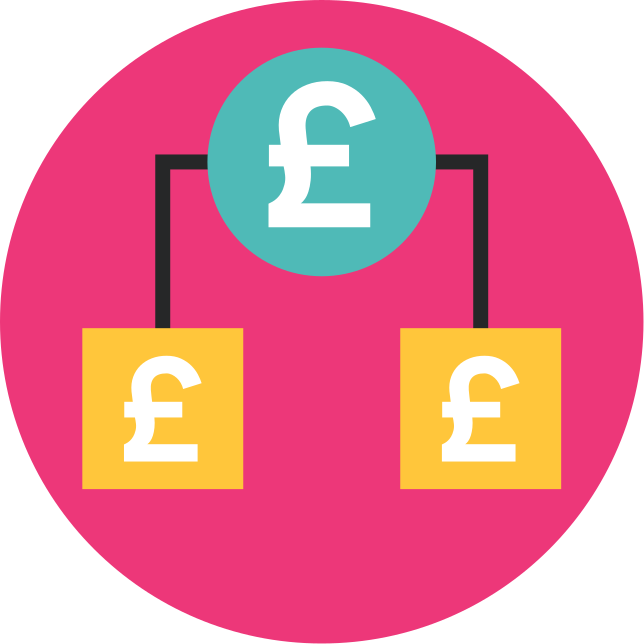
Pricing is where many booking tools hit their limits first. Health and wellbeing businesses often combine single sessions, courses, block bookings, memberships, introductory offers and concessions and the price for the same session can depend on location, time of day and the customer’s membership status. Expressing all of that through discount codes and manual adjustments is slow and prone to error.
A bespoke booking system treats pricing as a set of rules. Each rule is defined once and applied consistently, so customers see the correct price at the point of booking and staff no longer override prices by hand. Credits, packages and memberships can be tracked against each customer, with a clear record of what’s been used and what remains.
Rules also make change easier. When prices rise or a new membership tier launches, the change is made in one place and applies everywhere it should, with a history of which price applied when.
Payments, Calendars and Connected Systems
A booking is rarely the end of the process. Payment has to be taken, calendars updated, confirmations sent and the customer record kept current and each step touches a different system. Building booking around those connections is what removes the manual work that tends to grow alongside off-the-shelf tools.
Online card payments in the UK need to support strong customer authentication, which the FCA’s guidance on strong customer authentication explains and payment providers such as Stripe publish technical guidance on handling it. Staff calendars in Microsoft 365 can be kept in step through the Microsoft Graph calendar API.
-
1
Choose and book
The customer picks a location, service and time the system has confirmed is free. Availability reflects staff, rooms and equipment across every site.
-
2
Price and pay
Pricing rules calculate the correct amount, including any membership or package credit. Payment is taken through a provider such as Stripe or GoCardless.
-
3
Update records
The booking lands in staff calendars and the customer record is updated. Finance entries flow to Xero or QuickBooks without rekeying.
-
4
Remind and follow up
Confirmations and reminders go out automatically before the appointment. Cancellations release the slot so another customer can take it.
Each connection is built and tested against the platform’s own API and Priority Pixels connects booking tools to Stripe, GoCardless, Xero and QuickBooks as part of its web application work. Where more systems are involved, the wider approach to systems integration keeps every platform working from the same data.
Accessibility and Data Protection in Booking
A booking system is often the main way customers interact with the business online, so it needs to work for everyone. Time limits on holding a slot, small targets on calendar grids and date pickers that can’t be used with a keyboard are common barriers. WCAG 2.2 addresses these directly, including its guidance on adjustable time limits.
Health and wellbeing businesses also need to be careful with data. Booking notes, treatment types and health questionnaires can count as special category data under UK GDPR, which needs an additional condition for processing and stronger safeguards.
Test the booking journey with a keyboard alone before launch. If a customer can’t choose a date, select a slot and pay without a mouse, the journey needs more work.
Accessibility to WCAG 2.2 AA comes as standard in Priority Pixels web applications and a website accessibility review of the wider site makes sure the route into booking is just as usable as the booking itself. Keyboard navigation, screen reader compatibility and colour contrast are tested manually before launch rather than left to an automated scan.
Planning Booking System Development

Before speaking to any supplier, it helps to write down the rules your team applies every day. That list should cover how availability works, how prices are set, what happens on cancellation, which systems need to know about each booking and which exceptions staff handle by hand. Those exceptions are usually where the value of a bespoke system lies.
Cancellation and refund terms deserve particular attention. Consumer bookings made online fall within the scope of the Consumer Contracts Regulations 2013, which set out what information customers must be given and when cancellation rights apply, so the terms shown at booking should be checked against them during design.
Every Priority Pixels web application starts with a discovery call to understand the process, followed by a scoping session and a written proposal covering scope, cost and delivery dates. For a booking system, that discovery stage is where pricing rules, locations and any franchise structure are mapped in detail, so you can see what a bespoke build would involve before deciding whether it’s the right route.
FAQs
When is a bespoke booking system worth it?
A bespoke booking system usually pays off when a business has several locations, a franchise network or pricing that standard tools can’t express. It also makes sense when bookings need to flow into CRM, finance and calendar systems without manual work.
Can a booking system handle franchise networks?
Yes, a bespoke system can give each franchisee their own locations, staff and schedules while the franchisor controls pricing and branding centrally. Fees and royalties can be calculated from the same booking data.
What should a booking system connect to?
Most booking systems need to connect to a payment provider, staff calendars, a CRM and finance software. Common examples include Stripe or GoCardless for payments, Microsoft 365 for calendars and Xero or QuickBooks for accounts.

Co-Founder at Priority Pixels
Paul leads on development and technical SEO at Priority Pixels, bringing over 20 years of experience in web and IT. He specialises in building fast, scalable WordPress websites and shaping SEO strategies that deliver long-term results. He’s also a driving force behind the agency’s push into accessibility and AI-driven optimisation.

 Nathan Yendle | 02/10/2026