
How to Run an AI Readiness Assessment for Your Business
Plenty of businesses want to use AI but aren’t sure whether their data, processes and people are ready for it. An AI readiness assessment answers that question before money is spent on tools or development and it usually shows that some parts of the business are ready now while others need groundwork first. It’s also the first stage of the AI readiness consultancy for UK businesses that Priority Pixels offers, because an honest assessment is the cheapest way to avoid building the wrong thing.
The assessment doesn’t need to be a lengthy audit. For most mid-sized organisations it covers four areas and can be run by a small internal group with input from the teams who do the day-to-day work. What you end up with is a short, prioritised list of where AI could help, what needs fixing first and which ideas should be set aside for now.
What an AI Readiness Assessment Covers
Readiness has less to do with technology than it first appears. Most of the questions concern how your organisation already works, from the state of its records to the way decisions get approved and those answers decide whether an AI workflow will run reliably or struggle from the first week.
Looking at the four areas together gives a balanced picture. A business with excellent data but no agreed rules for using it is no more ready than one with clear policies and records scattered across personal inboxes.
Quality and access
Whether the information AI needs is accurate, current and held in systems you control. Access through an API matters as much as the data itself.
Repeatable work
Which tasks follow a recognisable pattern and happen often. These are where AI saves time most reliably.
Skills and confidence
How comfortable staff are checking AI output and spotting errors. Training needs usually show up here.
Rules and ownership
Who approves AI use and what data can be shared. Clear owners make every later decision faster.
Each area can be scored simply, for instance as ready, partly ready or not ready. The value comes from the conversations the scoring prompts rather than from the precision of the scores themselves.
Assessing Data Quality
Data is usually the area that decides how quickly AI can be put to work. An assistant that answers questions from your records, or a workflow that drafts reports from your figures, will only be as reliable as the information underneath it. Duplicate customer records, inconsistent product names and fields that different teams fill in differently all show up in AI output.
The government’s Data Quality Framework is written for the public sector, but its approach to judging whether data is fit for purpose works for any organisation. For a readiness assessment, the practical questions are which system holds the authoritative version of each record, how complete the key fields are and whether the system can be reached through an API. Where systems can’t talk to each other yet, connecting them through systems integration is often the groundwork that makes AI viable.
Organisations that want a more structured benchmark can borrow from the Data Maturity Assessment for Government, a self-assessment framework organised around topics and themes with five maturity levels. Most mid-sized businesses won’t need the full framework, although a handful of its questions can sharpen an internal review.
Mapping Processes and Finding Quick Wins
The second part of the assessment looks at where time goes. Sit with the people who run each process, not only the managers who describe it and note the steps that involve reading, sorting, summarising or retyping information. Those are the tasks AI handles well, particularly when a person can check the output quickly.
Quick wins tend to share a few traits. They happen daily or weekly, they already have a clear owner and a mistake would be caught before it reached a customer. Enquiry triage, meeting summaries and drafting routine reports are common examples and many businesses find that some of their candidates are better suited to rule-based process automation than to AI at all.
An AI Readiness Assessment Checklist
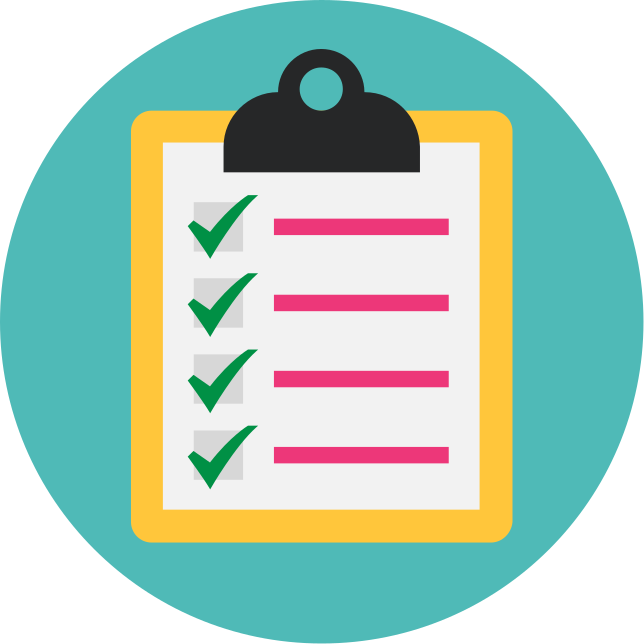
The questions below form a working checklist you can run through with department leads. Answer each one truthfully and note who owns the follow-up, because an unanswered question is itself a useful finding.
Try to complete the checklist in a single session with the right people in the room. Spreading it across several weeks tends to produce answers that describe how things should work rather than how they do.
- Do we know which system holds the authoritative version of our customer, supplier and financial records?
- Can those systems be reached through an API or a supported export?
- Have we listed the repetitive tasks that involve reading, sorting or summarising information?
- Does each candidate task have a named owner who would approve the AI output?
- Do we know which tasks involve personal data and might need a data protection impact assessment?
- Is there an agreed list of AI tools staff are allowed to use for work?
- Have staff been shown how to check AI output and what information must never go into a tool?
- Do we have a baseline for how long our candidate tasks take today?
- Is someone responsible for reviewing our use of AI as tools and guidance change?
Any question answered with a no or a shrug points to groundwork. None of these gaps rule AI out, but they shape which use cases can start now and which need to wait until the foundations are in place.
Skills, Culture and Governance
AI changes how people work, so readiness includes whether your teams are prepared to use it well. The most useful skill is judgement, which means knowing when an answer looks wrong, when to check a source and which information shouldn’t go into an AI tool. Staff who already use chat assistants informally often have good instincts that simply need structure.
Priority Pixels uses AI workflows in its own work every day, with a named person reviewing the output before anything reaches a client. That pattern of AI preparing the work and people making the decisions is a sensible model for staff guidance in any organisation.
List every AI tool staff already use before the assessment starts. The list often reveals the most popular use cases, along with the data risks that need addressing first.
Governance covers the rules that make AI safe to extend across the business. The Department for Science, Innovation and Technology’s AI Management Essentials tool is a useful self-assessment for this part and it was developed with input sought from start-ups and SMEs. Where personal data is involved, the ICO’s guidance on DPIAs explains when a formal assessment is required.
Security belongs in this part of the review too. If your organisation already holds Cyber Essentials, controls such as user access control and security update management will already be in place and AI workflows depend on those just as much as any other system does.
Turning the Assessment Into a Plan

The assessment is only useful if it leads to decisions. Rank the candidate use cases by the time they would save, the risk involved and how ready the supporting data is, then choose one to start with. Keep the others on a list and revisit them once the first workflow is running, since experience of one project usually changes how the rest are scored.
Some findings will point to work outside AI altogether, such as integrating two systems or tidying up a CRM and that’s a valid outcome. Our article on building a digital transformation strategy covers how those pieces fit into a longer roadmap.
If you’d prefer an outside view, the AI Readiness Consultancy from Priority Pixels is a short paid engagement covering discovery, a data audit and a set of priorities, delivered as a written plan. It includes honest advice on what to leave alone, which can save as much money as the ideas worth pursuing.
FAQs
What is an AI readiness assessment?
It is a structured review of whether your data, processes, people and governance can support AI. The result is a prioritised list of where AI could help and what groundwork is needed first.
How long does an AI readiness assessment take?
An internal assessment can often be completed in a small number of focused sessions with department leads. The time depends mainly on how many processes you review and how easy it is to find information about your data.
What if the assessment shows we are not ready for AI?
That is a useful result, because it shows which groundwork to do first, such as improving data quality or connecting systems. Many of those improvements pay back on their own before any AI is introduced.

Co-Founder at Priority Pixels
Paul leads on development and technical SEO at Priority Pixels, bringing over 20 years of experience in web and IT. He specialises in building fast, scalable WordPress websites and shaping SEO strategies that deliver long-term results. He’s also a driving force behind the agency’s push into accessibility and AI-driven optimisation.

 Nathan Yendle | 02/10/2026