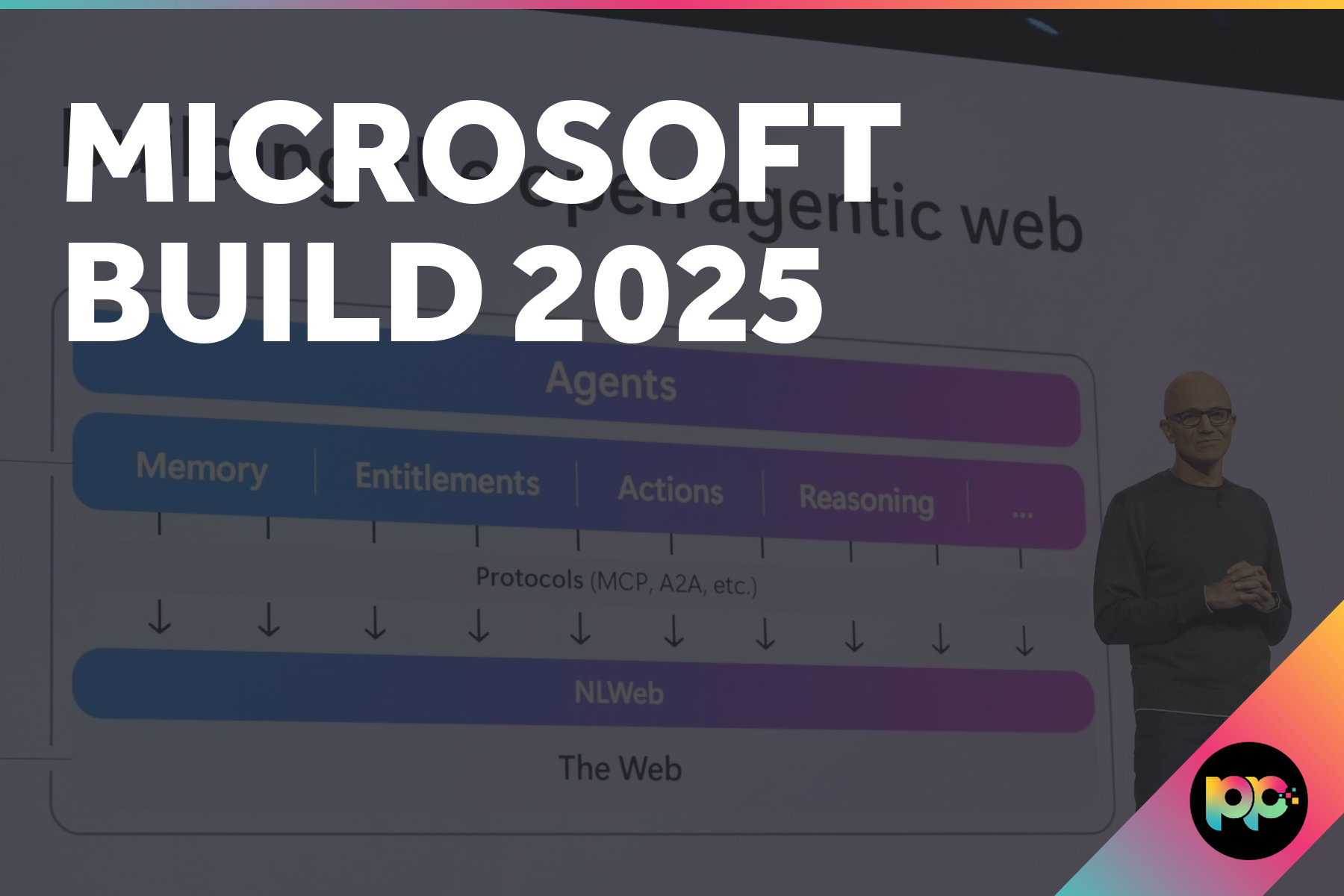
Microsoft Build 2025
What The New AI Agents Mean For Your Business
Microsoft Build 2025 took place in Seattle from 19 to 22 May and as expected, artificial intelligence was at the top of the agenda. While Microsoft has been integrating AI across its products for several years now, this year marked a more defined shift towards what it’s calling the “open agentic web”.
In his opening keynote, CEO Satya Nadella described a future where these AI agents are no longer assistants but active participants within software environments, capable of making decisions and performing tasks on behalf of users or entire organisations.
Microsoft’s announcements throughout Build 2025 revealed how it plans to make that future possible across its platforms, products and infrastructure. Here are the key takeaways.
Copilot Studio Fine-Tuning
Microsoft announced Microsoft 365 Copilot Tuning, a pre-release feature that lets organisations fine-tune large language models (LLMs) using their own company data. While not yet publicly available, it allows businesses to build task-specific agents tailored to their internal language, structure and processes. All fine-tuning happens within the Microsoft 365 environment, so data remains secure and subject to existing compliance controls. Using a no-code interface in Copilot Studio, subject-matter experts can train models on relevant documents, templates and policies, improving Copilot’s performance across tasks like document drafting, summarisation and domain-specific Q&A.
GitHub Copilot as a Coding Agent

GitHub Copilot is moving beyond suggestions and autocomplete functions. At Build 2025, Microsoft introduced the concept of Copilot as a fully autonomous coding agent. It’s now capable of performing more complex tasks such as debugging, writing test cases, extending functionality and generating documentation. It can carry out these actions within a secure virtual environment and log its outputs for developer review.
From our perspective, this has the potential to support developers by taking some of the repetitive, manual tasks off their hands. In theory, if it can reliably handle jobs like debugging or documentation, that frees up more time for developers to focus on structure, performance and user experience.
Multi-Agent Orchestration
Microsoft has also expanded support for multi-agent workflows within Azure AI Studio. Businesses can now build task-specific AI agents that work together on larger processes. One agent might extract data, another might analyse it and a third could generate a report or initiate a follow-up task.
These types of workflows are particularly relevant for operational processes that involve multiple steps or require information from different sources. This could include automating the production of weekly reports, processing internal documentation or reviewing compliance data. Microsoft’s introduction of the Model Context Protocol (MCP) standard is intended to ensure consistency in how these agents interact.
Azure AI Foundry and Model Management
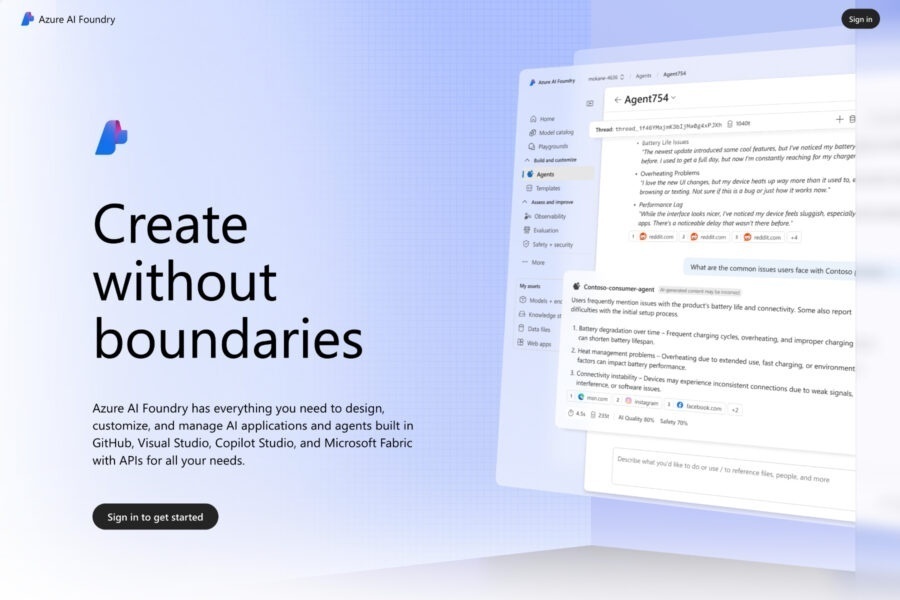
Azure AI Foundry is Microsoft’s central platform for accessing, managing and deploying AI models. At Build 2025, Microsoft confirmed it now supports over 1,900 models, including recent additions such as xAI’s Grok 3 and Grok 3 Mini.
The platform includes tools such as a model leader board, model router and usage analytics. This allows businesses to choose the most effective model for a specific use case, monitor its performance and manage associated costs. The benefit lies in being able to select from a wider range of models without investing in individual infrastructure or licensing arrangements.
Open Web Standards and Cross-Platform AI
Microsoft has introduced NLWeb, an open protocol designed to make web content more accessible and understandable for AI agents. Similar in purpose to HTML in the early web, NLWeb allows developers to define the structure and meaning of content on a webpage, such as labelling sections as product descriptions, service lists or contact options. This structured markup enables AI systems to interpret, summarise and interact with websites more effectively.
NLWeb also acts as a Model Context Protocol (MCP) server, which means any website using NLWeb automatically exposes its content in a standardised way for AI agents. While this does not currently affect SEO or search rankings, it could influence how conversational AI tools respond to queries or assist users on your site, especially in support or lead generation environments.
WSL Open Sourcing
Microsoft has made the Windows Subsystem for Linux (WSL) open source. WSL allows developers to run Linux distributions directly within Windows, which is useful for cross-platform software development and system administration tasks.
The decision to open source the project indicates Microsoft’s intention to support more collaborative development and increased transparency. For organisations working with open-source stacks, server-side code or containerised infrastructure, this change ensures long-term stability and integration with community-driven improvements.
What the Open Agentic Web Means for B2B Marketing
The introduction of the open agentic web signals a change in how digital content is surfaced and engaged with. Instead of serving content purely for human users, businesses will need to consider how AI agents interpret it too. These agents rely on structured data to understand what a site offers and to determine whether it meets a given need. That changes how visibility works online.
Content that’s clearly defined and semantically structured becomes more useful not just for search engines but to AI models that might be filtering, summarising or comparing your business against others, often before a person even lands on your site.
This doesn’t reduce the importance of traditional marketing principles, but it does introduce new questions around how content is created, labelled and presented. In a world where AI agents are browsing on behalf of people, the ability to make your services and expertise understandable to machines could quietly become a competitive edge.

Co-Founder & PPC Specialist at Priority Pixels
Nathan Yendle is Co-Founder of Priority Pixels and a Google Partner specialising in PPC strategy and campaign optimisation. With years of experience managing high-performance Google Ads accounts, Nathan focuses on data-driven decisions that deliver measurable results for B2B businesses and public sector organisations. His expertise spans paid search, display, and remarketing, helping clients maximise ROI through strategic planning and continuous improvement.
 Paul Clapp | 17/03/2026