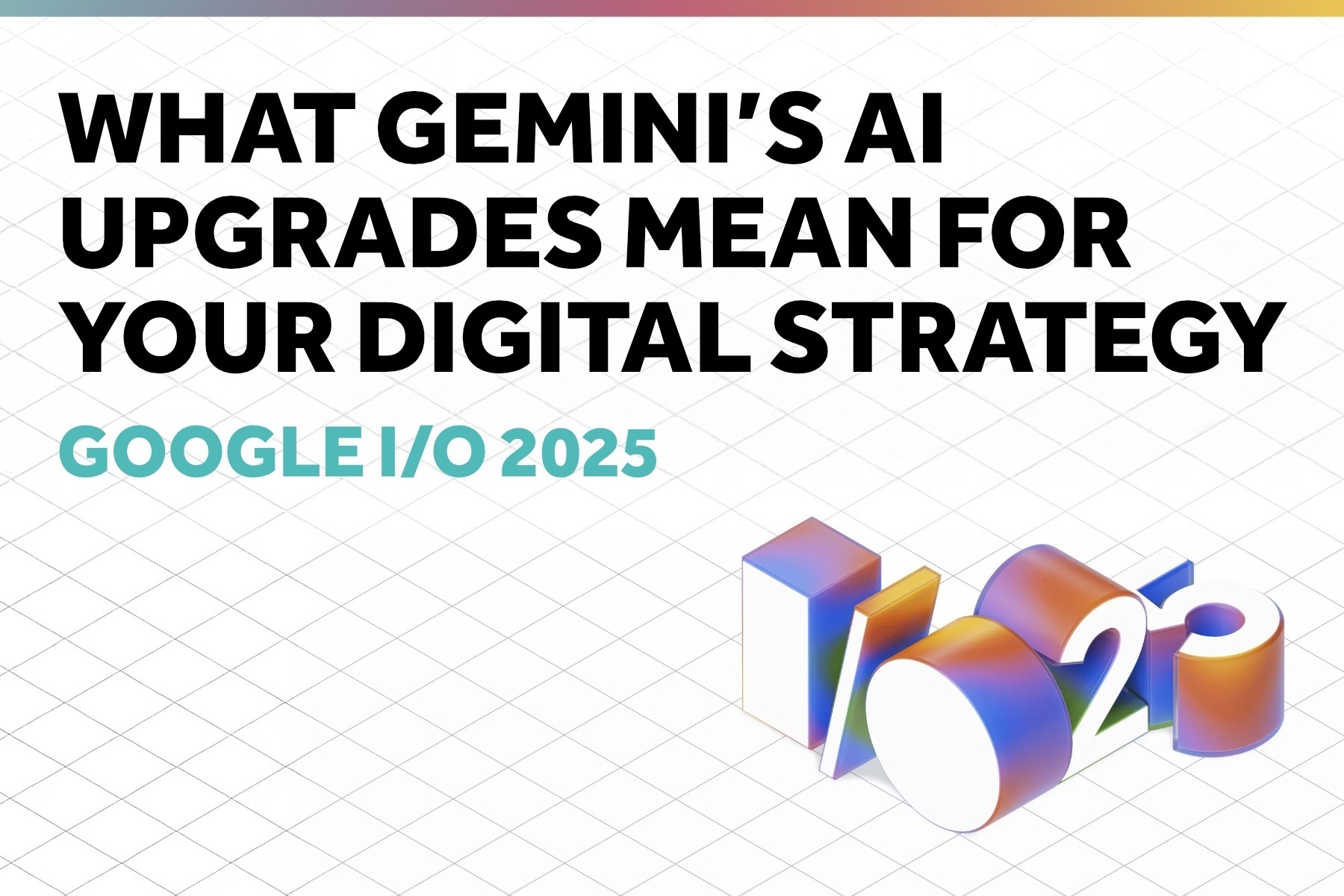
Google I/O 2025: What Gemini’s AI Upgrades Mean For Your Digital Strategy
Google’s I/O 2025 conference showed just how quickly AI is becoming part of everything from search visibility to content creation and development workflows. For businesses working with Priority Pixels, these updates bring both opportunities and important shifts in how digital strategy needs to evolve.
Here’s what matters.
Gemini AI: The Next Generation Of Models
The centrepiece of I/O 2025 was the expansion of Google’s Gemini models. The upgraded Gemini 2.5 family now includes both Gemini Pro and the faster, lighter Gemini Flash, delivering stronger performance for everything from complex reasoning to fast content generation. On-device models like Gemini Nano allow AI to run directly on mobile devices, while the upgraded Imagen 4 and Veo 3 models bring higher quality image and video generation.
For digital marketing teams, this opens up practical use cases in both content creation and automation. Blog visuals, social media graphics, product imagery and even basic video assets can now be generated or prototyped faster, freeing up more time for high-level creative and strategic work.
Gemini Live & Project Astra: Real-Time AI Interaction
Google’s Gemini Live (formerly Project Astra) pushes AI into real-time, multimodal interaction. Using your camera and voice, Gemini Live can observe, analyse and respond live to real-world inputs. This technology has clear future implications for sectors like eCommerce, customer support, AR shopping experiences and mobile user guidance.
While still emerging, this level of interaction could eventually allow businesses to offer AI-powered product support, guided shopping tools or visual search experiences directly on their websites or apps.
AI Search Overviews & AI Mode
Google continues to integrate AI deeply into search. AI Overviews now serve over 1.5 billion users every month, blending generative answers directly into search results. AI Mode introduces a conversational search interface, allowing users to interact with search as a live dialogue rather than a list of links. These changes reinforce the growing need for AI SEO, ensuring content is structured and surfaced effectively within AI-driven search experiences.
For SEO, this means optimising for AI-generated search results will become just as important as ranking in the traditional blue links. Structured data, strong content clarity and site authority will remain key to being surfaced in these new AI-driven formats.
Developer Tools: AI Embedded In Code & Cloud
For development teams, Google is making it easier to integrate AI directly into websites, apps and cloud workflows. Gemini Code Assist is now embedded into popular IDEs like Visual Studio Code, with full support inside Google Cloud’s Vertex AI platform.
This allows faster prototyping of new features, smarter development automation, and better integration of AI-powered features across client projects — whether that’s smarter forms, personalisation engines or customer service automation.
Generative Media Tools: Imagen 4 & Veo 3
Google’s upgraded media models provide direct creative tools for content teams:
- Imagen 4 produces higher-quality images for campaigns, blog assets and web visuals.
- Veo 3 now handles full video generation, including multi-scene video creation and synced audio.
These models offer a strong starting point for internal teams looking to draft or prototype creative assets quickly.
The Bigger Picture For Digital Strategy
What Google I/O 2025 confirms is simple: AI is becoming baked into every stage of digital. Search engines, content workflows, customer journeys and even web development itself are being redesigned to work alongside AI systems.
For businesses working with Priority Pixels, this isn’t about replacing your existing digital presence. It’s about how AI is changing the layers beneath it. Visibility in search, speed of creative production, site functionality and customer engagement are all shifting.
We’re already exploring how these technologies fit into client projects, testing where they deliver real improvements, and cutting through the hype to focus on what works.
If you want to know how any of these updates might apply to your business, let’s talk.

Co-Founder & PPC Specialist at Priority Pixels
Nathan Yendle is Co-Founder of Priority Pixels and a Google Partner specialising in PPC strategy and campaign optimisation. With years of experience managing high-performance Google Ads accounts, Nathan focuses on data-driven decisions that deliver measurable results for B2B businesses and public sector organisations. His expertise spans paid search, display, and remarketing, helping clients maximise ROI through strategic planning and continuous improvement.
 Paul Clapp | 16/03/2026
 Cara Vallance | 25/02/2026