
Google Ads for Professional Services: Managing Cost Per Lead in Competitive Markets
Professional services firms operate in some of the most expensive Google Ads markets in the UK. Solicitors, accountants, architects, financial advisers and consultancies all compete for a limited pool of high-intent searches where a single click can cost upwards of ten pounds. The reward for getting it right, though, is considerable. A new client in professional services often represents thousands of pounds in recurring annual revenue, which means the economics of paid search can work exceptionally well if campaigns are structured to reduce waste and attract the right enquiries. Google Ads management for professional services requires a different approach from consumer advertising. The buyers are more deliberate, the decision cycles are longer and the margin for wasted spend is thinner.
The challenge for most professional services firms is not whether Google Ads can generate leads. It clearly can. The challenge is controlling what those leads cost and making sure the people clicking through are genuine prospective clients rather than students researching a topic, competitors checking your positioning or individuals looking for free advice. Managing cost per lead in competitive markets comes down to precision in every part of the campaign, from keyword selection through to what happens after someone lands on your website.
Why Cost Per Lead Runs High in Professional Services
Several factors push CPL upwards in professional services markets. The first is competition. Multiple firms bid on the same keywords, often in the same geographic area, which drives cost per click up through the auction. Legal keywords are notoriously expensive, but accounting terms like “corporation tax adviser” or architecture terms like “commercial architect” carry significant click costs too. When the average CPC sits between five and fifteen pounds, you need a healthy conversion rate just to keep lead costs manageable.
The second factor is search volume. Professional services keywords tend to have lower search volumes than consumer markets. Fewer people search for “commercial property solicitor Bristol” than for “plumber near me”. That scarcity concentrates competition on a smaller number of available impressions, which pushes prices higher. Firms that spread their budget too thinly across too many keyword groups find that none of their campaigns gather enough data to perform well.
The third factor is intent ambiguity. Not everyone searching for “tax accountant” is looking to hire one. Some are researching the profession, others are looking for job vacancies and some are trying to find free tax calculators. Each irrelevant click erodes your budget without producing an enquiry. The firms that manage their CPL effectively are the ones that put significant effort into filtering out these non-commercial searches before they reach the ad auction.
Structuring Campaigns Around Service Lines
A common mistake in professional services Google Ads accounts is running a single campaign that covers everything the firm does. A solicitors’ practice that handles conveyancing, family law, commercial litigation and employment law should not group all of those services into one campaign. Each service line attracts a different audience with different search behaviour. The performance varies enormously between them. Separating service lines into individual campaigns gives you the control to allocate budget where returns are strongest and reduce spend where performance is weaker.
Campaign structure also affects Quality Score. Google rewards relevance. A tightly themed ad group with keywords, ads and landing pages all aligned around a single service will score better than a broad campaign trying to cover multiple services. Higher Quality Scores mean lower costs per click, which directly reduces your cost per lead. The structure of your account is one of the few areas where careful planning pays off before you spend a single pound on clicks.
| Service Line Example | Typical Search Intent | CPL Considerations |
|---|---|---|
| Commercial Property Law | Businesses seeking legal advice on leases, acquisitions or disputes | High CPC but strong client lifetime value offsets cost |
| Tax Advisory | Business owners researching tax planning, compliance or investigation support | Heavy filtering needed to exclude free calculator searches |
| Architectural Services | Developers or businesses commissioning commercial design work | Residential queries dominate search volume and must be excluded |
| Financial Planning | Individuals or businesses seeking regulated advice on investments or pensions | FCA compliance limits what ad copy can promise |
| Management Consultancy | Senior leaders evaluating external support for specific business challenges | Low volume requires broader geographic targeting to maintain impression share |
Within each campaign, ad groups should be built around tight keyword clusters. An employment law campaign might have separate ad groups for unfair dismissal, redundancy advice, settlement agreements and tribunal representation. Each ad group gets its own ad copy and ideally its own landing page. That level of granularity takes more time to set up, but the performance difference between a well-structured account and a loosely grouped one is significant over six to twelve months of campaign activity.
Keyword Strategy That Filters Out Unqualified Traffic

Keyword selection for professional services needs to prioritise commercial intent above volume. Bidding on broad, high-volume terms might look attractive in keyword research tools, but the traffic those terms generate is often a mixture of commercial buyers, information seekers and completely irrelevant audiences. Phrase match and exact match keywords give you more control over which searches trigger your ads, reducing the proportion of budget spent on clicks that will never convert.
Service-specific terms combined with commercial qualifiers produce the best results. Instead of bidding on “accountant” alone, target “corporation tax accountant for businesses” or “VAT advisory services”. For a law firm, “commercial lease solicitor” will outperform “solicitor” on conversion rate by a wide margin. The search volumes are lower, but the people using these longer, more specific phrases are much further along in their decision-making process. They know what they need and they are actively comparing providers.
Location modifiers add another layer of precision that is particularly relevant for professional services. Many clients prefer to work with a firm in their region, especially for services that involve face-to-face meetings. Adding geographic terms to your keywords, such as “employment solicitor Manchester” or “chartered accountant Leeds”, targets people who are looking for a local provider. This also reduces competition because you are no longer bidding against every firm in the country for the same generic terms.
Negative keywords deserve as much attention as your target keywords. For a professional services firm, the negative keyword list should include job-related terms (vacancies, careers, salary, training), educational terms (course, degree, qualification, how to become), free service terms (free advice, pro bono, legal aid) and DIY terms (template, calculator, self-assessment guide). According to WordStream’s guidance on negative keyword management, a well-maintained negative keyword list can reduce wasted spend by a considerable margin, which directly lowers your effective cost per lead.
Writing Ads That Speak to Professional Buyers
The people searching for professional services are not impulse buyers. They are business owners, finance directors, HR managers and property developers making considered decisions about who they trust with significant matters. Your ad copy needs to reflect that. Promotional language, countdown timers and phrases like “call now for a free quote” work against you in professional services. They signal a consumer-focused business rather than a credible firm.
Your headlines should communicate your specialism with clarity. “Commercial Property Solicitors, Birmingham” tells the searcher exactly what you do and where. Google’s responsive search ad format allows up to fifteen headline variations. Use them to cover your core services, geographic coverage, professional accreditations and years of experience. The algorithm tests different combinations against different searches, so providing a range of headline options improves performance over time.
Descriptions should reinforce credibility. Mention regulatory credentials (SRA regulated, ICAEW chartered, RICS accredited), sector experience and the type of clients you work with. A description like “Advising owner-managed businesses on tax planning for over 20 years” tells a potential client more about your firm than “Expert tax services available”. Specificity builds trust. Every element of your ad should give the searcher a reason to believe you understand their situation.
Ad extensions add visible detail without costing extra. For professional services, they serve as a qualification mechanism that helps the right people click through while discouraging those who are not your target audience. The main extension types to use are:
- Sitelink extensions pointing to specific service pages such as practice areas, team profiles and case studies
- Callout extensions highlighting credentials like “SRA Regulated”, “ICAEW Chartered” or “25 Years’ Experience”
- Structured snippet extensions listing your practice areas or sectors directly in the ad
- Call extensions displaying a phone number for firms where phone enquiries are a primary conversion route
- Location extensions showing your office address for clients who prefer local firms
These extensions increase the physical size of your ad on the results page, which improves visibility and click-through rates. They also give the searcher enough information to self-qualify before clicking, which means the people who do click are more likely to become genuine enquiries.
Landing Pages and the Conversion Path
The gap between a click and a conversion is where many professional services firms lose money. Sending paid traffic to a homepage or a generic “about us” page wastes the intent that brought someone to your site in the first place. If someone searched for “employment tribunal solicitor” and clicked your ad, they should land on a page that immediately confirms you handle tribunal work, explains your approach and makes it straightforward to get in touch. Anything less than that and you are paying for clicks that bounce without converting.
A professional services firm paying ten pounds per click but converting only 2% of visitors is spending five hundred pounds per lead. Improving that conversion rate to 5% through better landing pages cuts the cost to two hundred pounds. The landing page is often the biggest single lever for reducing CPL.
Each service line should have its own landing page, written specifically for the audience searching for that service. The page needs a clear headline that mirrors the search intent, a concise explanation of what you offer, credentials that build confidence and a prominent contact option. For professional services, the contact form should ask for enough information to qualify the lead but not so much that it deters people from completing it. Name, company, email, phone number and a brief description of their requirement is usually the right balance.
Page speed affects both user experience and campaign economics. Google factors landing page experience into Quality Score, so a slow page pushes your costs up while simultaneously driving visitors away. A well-built website with optimised images, efficient code and proper caching delivers a faster experience that keeps Quality Scores healthy. The firms that treat their website as a fixed cost rather than a performance asset tend to overpay for every lead their campaigns generate.
Trust signals matter more on professional services landing pages than in most other industries. Displaying professional body logos, client testimonials from named individuals, published case results (where regulations allow) and team profiles with genuine photographs all reduce the perceived risk of getting in touch. Professional buyers are cautious by nature. They are trusting your firm with legal matters, financial decisions or significant project budgets. Your landing page needs to earn that trust within seconds.
Bidding Strategies and Budget Allocation
Manual CPC bidding gives you the most control in the early stages of a campaign, before Google has enough conversion data to make automated bidding effective. Setting individual bids for each keyword lets you prioritise the terms most likely to generate qualified enquiries while limiting spend on keywords where you are less confident about intent. Once you have accumulated enough conversion data, typically thirty or more conversions over a thirty-day period, automated strategies like Target CPA or Maximise Conversions can take over the optimisation work.
Target CPA bidding tells Google the amount you are willing to pay for each conversion and lets the algorithm adjust bids in real time to hit that target. For professional services, this works well once you have a clear picture of what a qualified lead is worth. If your average client engagement is worth several thousand pounds and your typical close rate from enquiry to client is around one in four, you can calculate a CPL ceiling that keeps your campaigns profitable. Setting that ceiling as your Target CPA gives Google a clear performance benchmark to work towards.
- Start with manual CPC for the first four to eight weeks while gathering conversion data
- Move to Target CPA once you have at least 30 conversions in a 30-day window
- Set dayparting to focus budget on business hours when professional buyers are most active
- Allocate higher budgets to campaigns targeting your highest-value service lines
- Review geographic bid adjustments monthly to increase spend in areas producing the strongest leads
Budget allocation should reflect the commercial value of each service line, not just its search volume. An architecture firm might find that commercial interior design generates more searches than planning consultancy work, but if planning consultancy clients have a higher lifetime value, that service line deserves a proportionally larger share of the budget. The right allocation changes over time as you gather performance data, so quarterly budget reviews should be built into your campaign management routine.
Paid search management for professional services firms requires patience that runs counter to how most firms evaluate marketing spend. A three-month test is rarely long enough to judge campaign effectiveness in markets with long decision cycles. The accountancy firm that spends twelve months refining its keyword lists, improving its landing pages and building up Quality Scores will consistently outperform the firm that expects immediate results from a freshly launched campaign. Google Ads compounds over time when it is managed with that longer perspective in mind.
Measuring Return Beyond the Initial Enquiry
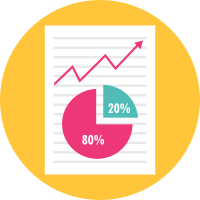
Tracking form submissions and phone calls gives you a lead count, but it does not tell you whether your Google Ads investment is producing profitable client relationships. Professional services firms need to connect their ad spend to revenue. That requires tracking leads through to engagement and beyond. Integrating your CRM with Google Ads conversion tracking lets you feed actual client values back into the platform, which improves the accuracy of automated bidding strategies and gives you a genuine return-on-investment figure rather than a cost-per-lead approximation.
Attribution modelling is particularly relevant for professional services. A managing director might see your ad, visit your website, leave without enquiring, return via an organic search a fortnight later, read a blog post and then call your office the following week. Standard last-click attribution would credit that conversion entirely to organic search, ignoring the role paid search played in the initial discovery. Data-driven attribution distributes credit across the touchpoints that contributed to the conversion, giving a more accurate picture of how your campaigns are performing.
Offline conversion tracking bridges the gap between online clicks and real-world client engagements. When a lead from Google Ads becomes a paying client, that outcome can be uploaded back into Google Ads as an offline conversion. Over time, this data teaches the algorithm what a valuable lead looks like, which improves targeting and reduces the proportion of budget spent on clicks that do not convert. According to Search Engine Journal’s guidance on PPC measurement, firms that track conversions through to revenue consistently achieve lower CPL figures than those measuring only front-end lead volume.
The professional services firms getting the strongest results from Google Ads are those that treat it as an integrated part of their business development rather than a standalone marketing channel. When organic search drives awareness, paid search captures high-intent queries and the website converts visitors into qualified enquiries, the cost per lead becomes manageable even in competitive markets. Paid search does not exist in isolation. Its performance is shaped by the quality of your website, the clarity of your service proposition and the speed with which your team follows up on every enquiry that comes through.
FAQs
What is a good cost per lead for professional services Google Ads?
A good cost per lead varies significantly by service type and geography. Legal services tend to carry higher CPLs than accountancy or consultancy. The right benchmark for your firm depends on your average client lifetime value and your close rate from enquiry to engagement. If a new client generates several thousand pounds in annual fees, a CPL of two or three hundred pounds may be entirely profitable.
How long does it take for Google Ads to produce results for a professional services firm?
Most professional services campaigns need three to six months to reach a consistent performance level. The first few weeks are spent gathering data, refining keyword lists and building Quality Scores. Automated bidding strategies require at least 30 conversions in a 30-day period before they can operate effectively. Firms that commit to twelve months of ongoing management typically see their CPL decrease steadily as campaigns mature.
Should professional services firms use broad match keywords in Google Ads?
Broad match can be useful once a campaign has accumulated significant conversion data and the automated bidding algorithm has learned which searches produce valuable leads. For new campaigns or firms with limited budgets, phrase match and exact match provide more control and reduce the risk of budget being spent on irrelevant searches. Broad match should be introduced gradually alongside a strong negative keyword list.
How important are landing pages for reducing cost per lead?
Landing pages are one of the most significant factors in CPL reduction. A dedicated landing page that matches the search intent, clearly presents the service and makes it easy to enquire will convert a higher proportion of visitors than a generic homepage. Improving conversion rate from 2% to 5% can reduce effective CPL by more than half without any change to keyword bids or budget.
Can small professional services firms compete with larger firms on Google Ads?
Smaller firms can compete effectively by focusing on specific service niches and geographic areas where larger firms may not be bidding. A sole practitioner specialising in employment tribunal representation in a specific region faces far less competition than a full-service firm trying to advertise across every practice area nationally. Specificity in targeting is the advantage smaller firms have over larger competitors with broader campaigns.

Co-Founder & PPC Specialist at Priority Pixels
Nathan Yendle is Co-Founder of Priority Pixels and a Google Partner specialising in PPC strategy and campaign optimisation. With years of experience managing high-performance Google Ads accounts, Nathan focuses on data-driven decisions that deliver measurable results for B2B businesses and public sector organisations. His expertise spans paid search, display, and remarketing, helping clients maximise ROI through strategic planning and continuous improvement.


 Paul Clapp | 16/02/2026