
Website Design for Construction Companies: Showcasing Projects That Win Work

A construction company’s website does more than list services and contact details. It is the place where architects, developers, project managers and procurement teams form their first impression of the business. In a sector where contracts are won on reputation and proven capability, a website that fails to present completed work effectively is a missed opportunity every time someone searches for a contractor. Investing in web design for construction companies means building something that works as hard as the team on site, turning project photography and technical detail into a commercial asset that helps win new work.
The construction industry has been slower than many sectors to adopt digital marketing. Word of mouth and established relationships still drive a significant share of new business. But the buying process has changed. Quantity surveyors search online before shortlisting contractors. Main contractors check subcontractor websites before sending invitations to tender. Housing developers review portfolios before picking a design and build partner. If your website does not present your projects in a way that builds confidence quickly, someone else’s will.
Why Project Portfolios Matter More Than Service Pages
Most construction company websites follow a predictable pattern. There is a homepage with a slider, a services page listing everything from groundworks to fit-out, an about page with a few paragraphs about company history and a contact form. What is often missing is the single most persuasive element a construction website can have: a well-presented portfolio of completed work.
Service pages tell people what you do. Project pages show them what you have done. In construction, where the quality of finished work is visible and measurable, that distinction matters enormously. A quantity surveyor reviewing tenders does not want to read that you offer “high-quality commercial fit-outs.” They want to see photographs of completed fit-outs, understand the project scope, know the contract value range and see evidence that you delivered on time and within specification.
Project portfolio pages also serve a practical SEO purpose. Each completed project gives you an opportunity to target location-based and sector-specific search terms. A project page titled “Office Refurbishment in Bristol for Financial Services Client” naturally targets search queries that a generic services page never will. Over time, a library of well-optimised project pages builds search authority across the regions and sectors where you operate.
The strongest construction websites treat every completed project as a content asset. Detailed project pages with professional photography, clear scope descriptions and measurable outcomes do more to win tenders than any amount of marketing copy on a services page.
Getting the structure of those project pages right is where the real work begins. A gallery of photographs without context is a missed opportunity. The pages that convert visitors into enquiries are the ones that tell the story of each project in a way that answers the questions buyers are already asking.
Structuring Project Pages That Build Confidence
A project page is not a photo gallery. It is a commercial document that needs to answer the questions a prospective client will ask before they pick up the phone. Who was the client? What was the scope? What were the constraints? How did the project progress? What was the outcome? Structuring project pages around these questions gives visitors the information they need to assess your suitability for their own project.
Professional photography is the foundation. Construction photography is a specific skill. Wide-angle shots that capture the scale of a build, detail shots that show quality of finish, drone photography that shows site context and progress shots that demonstrate programme management all serve different purposes. Investing in professional photography for every significant project pays for itself many times over through the credibility it adds to the website.
Each project page should include a summary panel with key facts: client name (where permission is given), sector, contract value range, location, duration and services provided. This structured data helps visitors quickly assess whether the project is comparable to their own requirements. Below the summary, a narrative section describing the brief, the approach and the outcome gives depth that raw facts alone cannot provide.
| Project Page Element | Purpose | Why It Matters |
|---|---|---|
| Professional photography | Visual evidence of completed work | Builds immediate credibility with decision makers reviewing portfolios |
| Key facts panel | Quick reference (sector, value, location) | Helps visitors assess relevance to their own project requirements |
| Project narrative | Context on brief, approach and outcome | Demonstrates problem-solving capability and delivery process |
| Testimonial or client quote | Third-party endorsement | Adds trust that self-authored content cannot replicate |
| Related projects | Internal linking to similar work | Keeps visitors engaged and demonstrates depth of experience in a sector |
When all of these elements work together, a project page becomes a self-contained pitch for your company’s capability. Visitors can assess your relevance to their own project within thirty seconds and decide whether to get in touch.
Photography and Visual Content That Sells Construction Work

The difference between a construction website that converts enquiries and one that does not often comes down to the quality of visual content. Stock photography is immediately recognisable and undermines credibility. Photographs taken on a phone during site visits rarely capture work at its best. Professional construction photography, shot at the right time of day with proper equipment and an eye for composition, turns a finished project into something that prospective clients can picture for themselves.
Drone photography has become particularly valuable for construction portfolios. Aerial shots of completed housing developments, infrastructure projects and commercial buildings provide perspective that ground-level photography cannot match. They also demonstrate the scale of work in a way that text descriptions struggle to convey. For civil engineering and infrastructure work, drone footage of completed earthworks, bridge installations or road schemes adds a dimension that is difficult to replicate any other way.
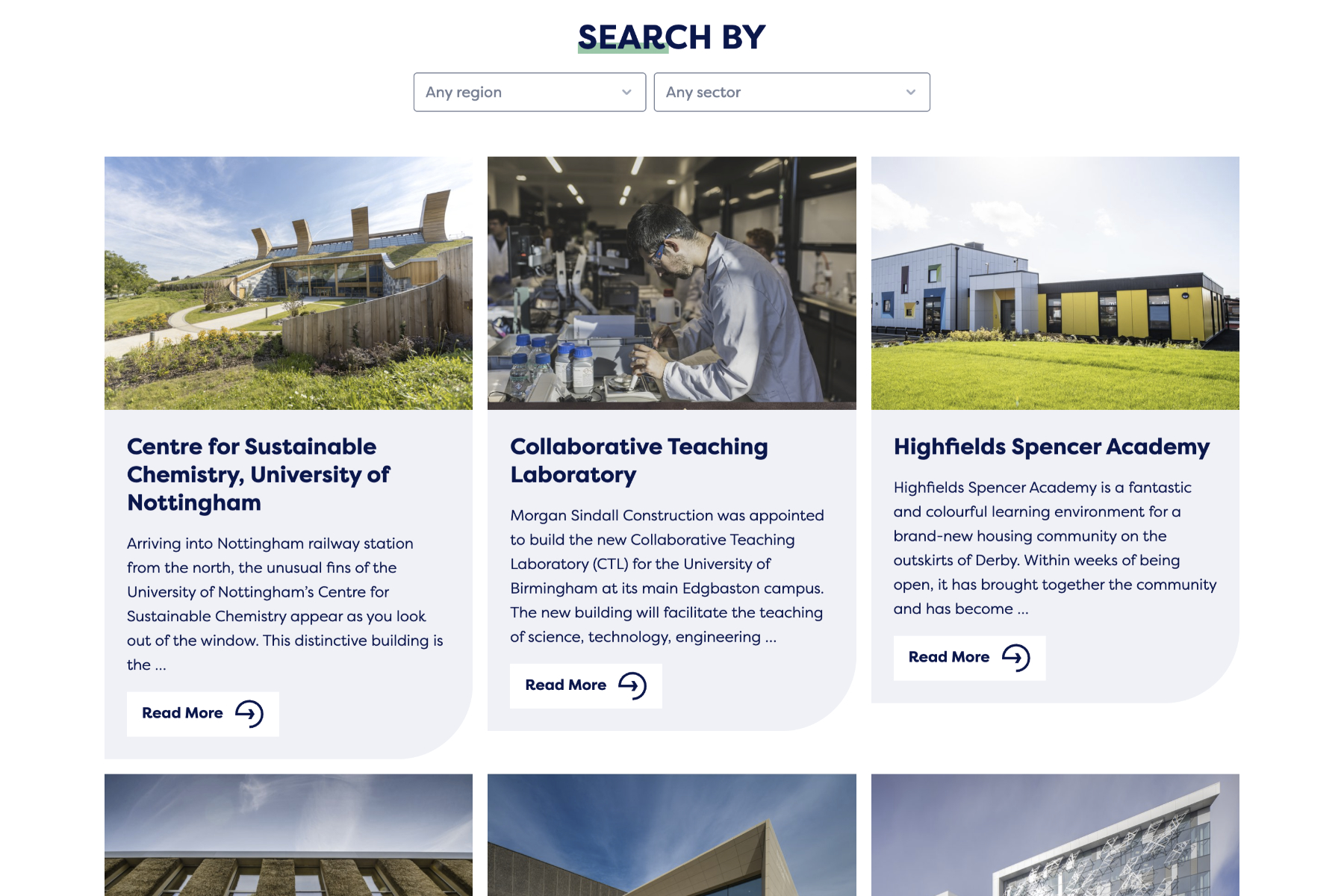
Time-lapse photography and progress imagery serve a different but equally important function. Showing a project from foundation to handover demonstrates programme management capability and attention to quality at every stage. Some construction companies commission time-lapse cameras on their larger projects specifically for marketing purposes. The resulting videos and image sequences are powerful content for both websites and LinkedIn campaigns targeting decision makers in their sector.
Image optimisation matters as much as image quality. Large, uncompressed photographs slow page loading times significantly. On construction websites with dozens of project pages, each containing multiple high-resolution images, poor image handling can create serious performance problems. Modern formats like WebP reduce file sizes without visible quality loss. Lazy loading ensures images below the fold do not slow down the initial page render. These are technical details, but they directly affect whether a visitor stays on the site long enough to view the portfolio.
Making Your Website Work for Tender Submissions
In many construction sectors, websites play a direct role in the tendering process. Main contractors reviewing subcontractor submissions will check the website. Public sector procurement teams use websites to verify claims made in PQQ and ITT responses. Framework assessment panels look at online presence as part of their evaluation. A website that supports the tendering process is one that makes it easy to verify capability, experience and credentials.
Accreditations and certifications should be prominently displayed. CHAS, Constructionline, SSIP, ISO certifications, CSCS and any sector-specific accreditations should be visible on the homepage or a dedicated accreditations page. For construction companies working in regulated environments like healthcare, education or defence, displaying the relevant clearances and certifications is not optional. Procurement teams will check. If they cannot find what they need on your website, they may not ask. They may simply move to the next applicant.
Search visibility also feeds into the tendering process indirectly. Procurement teams do not always use formal frameworks. Sometimes they search Google for contractors in a specific region or specialism. If your website does not appear for searches like “commercial fit-out contractor Bristol” or “school refurbishment contractor South West,” you are invisible to a segment of the market that is actively looking for what you do.
Health and safety information deserves its own section or page. Construction buyers need to see that you take health and safety seriously. Your website should display your health and safety policy statement, accident frequency rates (if you track them), relevant training records and any awards or recognition for safety performance. This is not marketing material. It is evidence that procurement teams need to see. Presenting it clearly on your website saves time for both parties during the pre-qualification process.
Beyond the content itself, procurement teams check for specific signals when reviewing contractor websites during pre-qualification. The items they look for most consistently include:
- CHAS, Constructionline and SSIP membership status displayed prominently
- ISO certification details with certificate numbers where possible
- CSCS and industry body membership (CIOB, FMB or relevant trade associations)
- Insurance documentation or confirmation of adequate cover levels
- A published health and safety policy with accident frequency data
- Named project references with sector and contract value range
Presenting these items in a structured, easy-to-find format saves procurement teams time and signals that you understand how contractor evaluation works. The firms that make this information accessible on their websites are the ones that get through pre-qualification without unnecessary back-and-forth requests for documentation.
Technical Considerations for Construction Websites
Construction websites face some specific technical challenges that general business websites do not. The volume of high-resolution imagery creates performance demands that need careful management. Project filtering and search functionality needs to work well across devices. Contact forms need to route enquiries to the right department or regional office. Integration with CRM systems helps track which projects and pages generate the most valuable leads.
WordPress handles these requirements well when properly implemented. Custom post types for projects allow structured data entry and consistent presentation. Taxonomy systems let visitors filter projects by sector, region, contract value or service type. The media library handles large image volumes efficiently when combined with server-side optimisation and a content delivery network.
Mobile responsiveness is not about shrinking desktop layouts onto smaller screens. It is about considering how people use construction websites on mobile devices. Site managers checking a subcontractor’s website from a construction site. Quantity surveyors reviewing portfolios on a tablet during a tender evaluation meeting. The experience on these devices needs to be quick and functional, with project imagery that loads fast and key information that is easy to find without excessive scrolling.
Page speed has a direct relationship with user engagement. According to Google’s Core Web Vitals guidance, pages that load slowly see higher bounce rates and lower engagement across every industry. For construction websites where the average visitor may be reviewing several competitor sites in a single session, a slow-loading portfolio page can mean losing an opportunity before the visitor has seen a single project.
Content Strategy Beyond the Portfolio
Project portfolios are the centrepiece, but they are not the only content a construction website needs. Blog content and technical articles serve a dual purpose: they build search authority across a wider range of keywords and they demonstrate expertise in specific areas that project pages alone cannot address.
A construction company specialising in heritage refurbishment might publish articles on working with listed buildings, conservation area requirements or specific restoration techniques. A commercial fit-out contractor could write about workplace design trends, regulations affecting office builds or the practical differences between Cat A and Cat B fit-outs. This kind of content attracts search traffic from people researching topics related to your specialism and positions your company as a knowledgeable partner rather than just another contractor.
Content planning for construction websites works best when tied to the commercial calendar. Tendering cycles, framework renewal periods and seasonal project patterns all create opportunities for timely content. An article on school refurbishment published in January, when education procurement teams are planning summer works, reaches the right audience at the right moment. Content that aligns with when buyers are making decisions is more effective than content published at random intervals.
The construction companies that get the most value from their content are the ones that publish to the procurement calendar, not their own marketing schedule. Timing a piece on education sector refurbishment to land before summer planning begins puts your firm in front of buyers at the exact point they start searching for contractors.
Testimonials and case study quotes add credibility that self-authored content cannot match. Where possible, include named testimonials from clients, architects or project managers who can speak to the quality of your work. Video testimonials are particularly effective, though written quotes with attribution work well when video is not practical. The key is authenticity. A generic “great job, would recommend” quote from an unnamed source adds nothing. A specific endorsement from a named professional describing what you delivered and why it mattered carries real weight.
Measuring What Matters on a Construction Website

Traffic numbers alone do not tell you whether a construction website is performing well. A site that gets 500 visits a month from the right people, quantity surveyors, project managers and procurement professionals, is more valuable than one that gets 5,000 visits from people searching for DIY advice. The metrics that matter are the ones that connect website activity to commercial outcomes.
Four areas deserve regular attention when measuring website performance for a construction business:
- Enquiry quality: the relevance and commercial value of leads generated through the site
- Portfolio engagement: time on project pages, scroll depth and click-through to related work
- Search visibility: which queries bring visitors and where ranking gaps exist
- Competitor positioning: where rivals outperform you and what their sites do differently
Enquiry quality is the first metric to track. Not just the number of contact form submissions, but the value and relevance of the enquiries received. Setting up proper tracking in Google Analytics with event tracking for form submissions, phone number clicks and email link clicks gives you a baseline for measuring lead generation. Over time, correlating these metrics with actual won work tells you which pages and which projects generate the most valuable enquiries.
Portfolio engagement metrics reveal which projects connect with visitors. Time on page, scroll depth and click-through to related projects all indicate whether your project pages are doing their job. If visitors consistently leave project pages quickly, the content or photography may not be meeting their expectations. If they spend time on project pages but do not submit an enquiry, the call to action or contact process may need attention.
Search performance data from Google Search Console shows which queries bring visitors to your site and which pages appear in search results. For construction companies, monitoring performance for location-based and sector-specific queries reveals where you are visible and where gaps exist. If you complete commercial projects across the South West but your website does not rank for any commercial construction queries in that region, the content and optimisation strategy needs adjusting.
Competitor benchmarking rounds out the picture. Knowing where your competitors rank for the search terms that matter to your business helps prioritise content and optimisation work. If a competitor consistently outranks you for a specific sector or region, examining what their website does differently, whether that is more detailed project pages, better-optimised content or stronger technical performance, gives you a roadmap for improvement.
FAQs
What should a construction company website include?
A construction company website should include a well-structured project portfolio with professional photography, clear scope descriptions and measurable outcomes for each completed project. Service pages, accreditation details, a key facts panel for each case study and strong calls to action are all important. The portfolio is the most persuasive element because procurement teams want to see evidence of past delivery rather than just a list of services offered.
How do I showcase construction projects on my website?
Each project should have its own dedicated page with professional photography, a summary panel covering the client sector, location, contract value range and duration. Include a narrative section explaining the brief, the challenges faced and the outcome delivered. Structured project pages help visitors assess whether your experience is relevant to their own requirements.
Why is a portfolio important for a construction website?
Procurement teams evaluate contractors based on evidence of past performance. A detailed portfolio shows what you have delivered rather than simply claiming you can do the work. Each project page also targets sector-specific and location-based search terms, building SEO authority over time in the regions and markets where you operate.
Do construction companies need professional photography for their websites?
Professional construction photography is one of the highest-return investments a construction firm can make in its website. Wide-angle shots that show scale, detail images that demonstrate quality of finish and drone photography that captures site context all serve different purposes. Stock imagery or poor-quality phone photos undermine the credibility you are trying to build with decision makers.

Co-Founder at Priority Pixels
Paul leads on development and technical SEO at Priority Pixels, bringing over 20 years of experience in web and IT. He specialises in building fast, scalable WordPress websites and shaping SEO strategies that deliver long-term results. He’s also a driving force behind the agency’s push into accessibility and AI-driven optimisation.


 Nathan Yendle | 09/01/2026