AI Search for Construction Companies: Staying Visible in a Changing Search Landscape
The way search engines deliver information is changing. Google’s AI Overviews, Bing’s Copilot responses and the growing use of ChatGPT for research queries all point in the same direction: search results are becoming more synthesised and less about presenting ten blue links for the user to click through. For construction companies that have invested in their websites and SEO over the years, this shift raises a serious question. If AI is summarising answers directly in search results, what happens to the organic traffic those websites depend on? Firms working with an agency that provides digital services for construction companies need to understand these changes now, rather than reacting after the impact has already hit their pipeline.
Construction has never been a sector that moves quickly on digital trends. That caution is often justified. But the changes happening in search right now are structural, not cosmetic. They affect how procurement teams research contractors, how project managers find specialist suppliers and how your business appears when someone asks an AI tool to recommend a groundworks company or a commercial fit-out specialist in their region. Ignoring this does not make it go away. It means your competitors who are paying attention will be the ones AI search surfaces first.
What AI Search Means for the Construction Sector
Traditional search has worked well for construction companies that invested in SEO. A procurement manager types “commercial building contractor Manchester” into Google, reviews the results, clicks through to a few websites and starts building a shortlist. The websites that ranked well got the visits. The ones with strong content and clear credentials won the enquiries. It was a system that rewarded good websites with qualified traffic.
AI search changes the mechanics of that process. When Google generates an AI Overview for a search query, it pulls information from multiple sources, synthesises it into a summary and presents it at the top of the results page. The user might get a useful answer without clicking through to any website at all. For informational queries, this is already happening at scale. For commercial queries with clear buyer intent, the picture is more nuanced, but the direction of travel is clear.
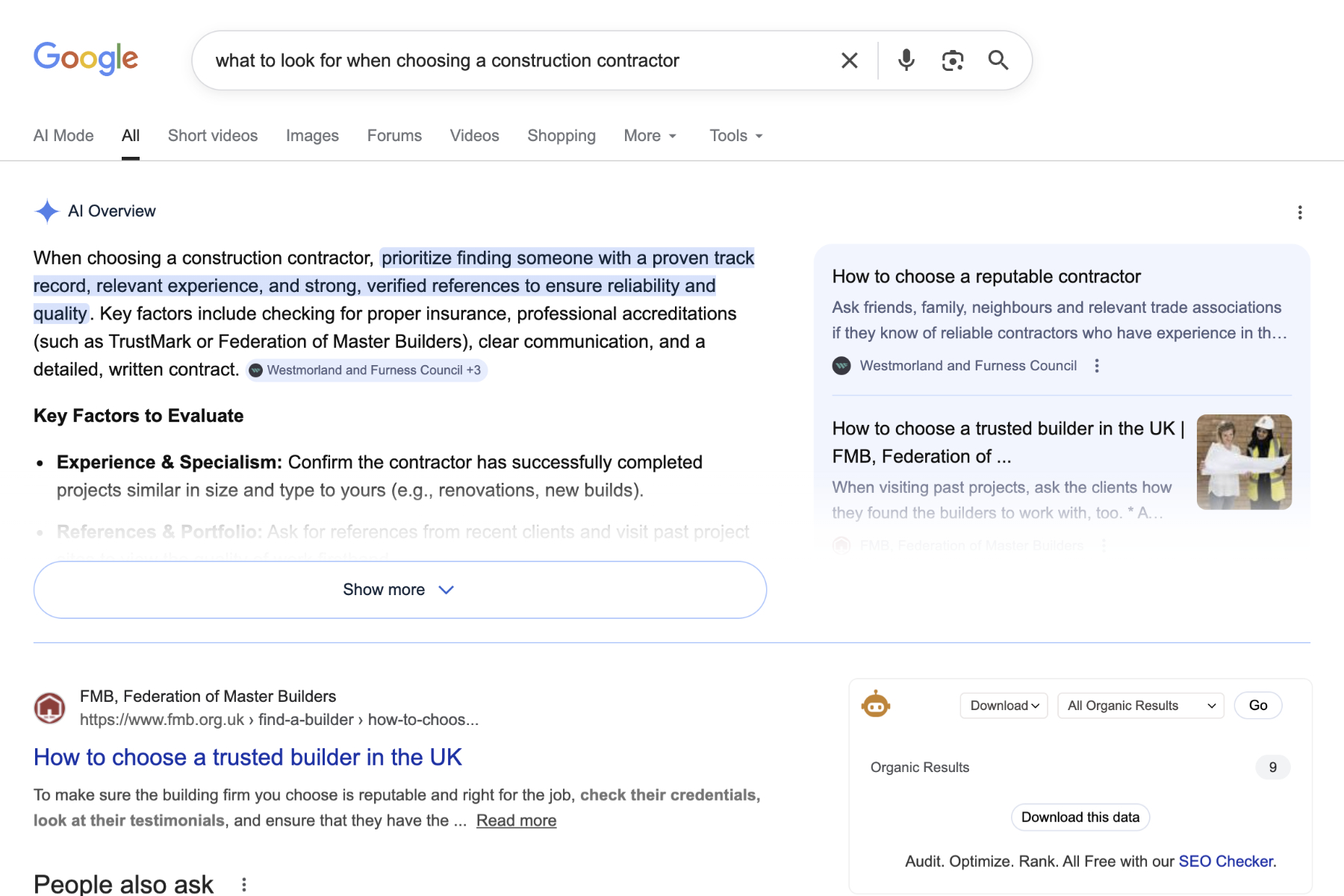
The implications for construction companies are specific. Procurement teams are increasingly comfortable using AI tools to conduct initial research. A quantity surveyor might ask ChatGPT to list contractors specialising in healthcare fit-out projects in the South East. A facilities manager might use Google’s AI features to compare approaches to sustainable construction. If your business and its expertise are not represented in the data these AI tools draw from, you will not appear in those answers. Being invisible to AI search is becoming as commercially damaging as being invisible in traditional organic results.
How AI Tools Source Information About Contractors
Understanding where AI search tools get their information helps construction companies position themselves effectively. These systems do not simply check who ranks first on Google and copy the answer. They aggregate information from a broader range of sources and synthesise responses based on patterns of authority, relevance and consistency.
Your website remains the primary source. AI tools crawl and index website content just as traditional search engines do. The difference is in how they process it. Rather than matching keywords to pages, AI systems look for well-structured, authoritative content that directly answers questions. A service page that clearly explains what your company does, which sectors you serve and what accreditations you hold gives AI tools concrete information to reference. A vague page full of marketing language gives them nothing to work with.
Third-party sources matter more in AI search than in traditional SEO. Industry directories like Constructionline, membership bodies such as CIOB and professional certifications all contribute to the data pool that AI systems draw from. If your business is consistently represented across these platforms with accurate, detailed information, AI tools are more likely to include you in their responses. Inconsistent or outdated information across different platforms creates confusion that AI systems tend to resolve by simply omitting you.
Reviews, case studies published on third-party sites, press coverage in trade publications and mentions on industry forums all feed into AI understanding of your business. The broader and more consistent your digital footprint, the more material AI tools have to draw from when generating responses about contractors in your sector and region.
Traditional SEO and AI Search Are Not the Same Thing
There is a temptation to assume that if your SEO strategy is working well, AI search will take care of itself. That assumption is risky. Traditional SEO and AI search optimisation overlap in some areas, but they are not identical disciplines. The tactics that rank your service pages in Google’s organic results are necessary but not sufficient for AI search visibility.
Traditional SEO focuses on ranking specific pages for specific keywords. You optimise your “commercial fit-out contractor” page to rank for that term. When it appears on page one, you receive traffic from people searching for it. AI search works differently. Instead of directing users to your page, the AI system might answer the user’s question directly using information extracted from your page, alongside information from other sources. Your page might be cited as a reference. It might not appear at all. The traffic benefit is less predictable.
| Factor | Traditional SEO | AI Search Optimisation |
|---|---|---|
| Primary goal | Rank pages for target keywords | Be cited as an authoritative source in AI-generated answers |
| Content format | Keyword-optimised pages and blog posts | Clear, factual content that directly answers questions |
| Technical requirements | Page speed, mobile usability, crawlability | Structured data, schema markup, consistent entity information |
| Off-site signals | Backlinks from authoritative domains | Consistent presence across directories, mentions, and third-party content |
| Traffic pattern | Click-through from search results page | May receive citation without click-through |
The structural requirements also differ. AI tools respond well to content that is organised around clear questions and direct answers. FAQ sections, well-structured service descriptions and detailed project case studies give AI systems specific factual content to reference. Long paragraphs of promotional copy that talk around a subject without saying anything concrete are far less useful to AI tools than concise, authoritative statements backed by evidence.
Schema markup takes on greater importance in AI search. Structured data helps AI tools understand the entities on your website: your company, your locations, your services, your accreditations. LocalBusiness schema, Organization schema and FAQPage schema all provide machine-readable information that AI systems can process more reliably than unstructured text. Construction companies that implement structured data gain an advantage because so few in the sector have bothered with it.
Practical Steps for Construction Companies

Preparing your website and digital presence for AI search does not require a complete overhaul of your marketing strategy. Many of the changes align with good practice that would improve your traditional SEO performance as well. The key is to think about your content and online presence from the perspective of an AI system trying to answer questions about contractors in your sector.
Start with your service pages. Each one should clearly state what you do, which sectors you serve, where you operate and what accreditations or certifications you hold. Remove vague marketing language and replace it with specific, factual information. If you specialise in healthcare construction, say so directly and mention the relevant accreditations, compliance requirements and project types you handle. AI tools looking for healthcare construction contractors need concrete facts, not abstract claims about quality and commitment.
Audit your presence across industry platforms. Check your listings on Constructionline, CHAS, CIOB, Build UK and any other industry bodies you belong to. Make sure your company name, address, contact details, service descriptions and accreditations are accurate and consistent across every platform. Inconsistencies between your website and your directory listings undermine the consistency signals that AI tools rely on when deciding which sources to trust.
AI search tools favour businesses with consistent, detailed information across multiple sources. A construction company that appears with matching details on its website, industry directories and professional body listings is far more likely to be cited in AI-generated answers than one with fragmented or outdated information.
Create content that answers the questions your target audience asks. Procurement teams researching contractors want to know about your experience in specific sectors, your approach to programme management, your health and safety record and your accreditation status. Write content that addresses these questions directly. FAQ pages, detailed service descriptions and project case studies that cover brief, approach and outcome all give AI tools the kind of structured, factual content they prioritise.
AI SEO is still an emerging discipline, but the foundations are straightforward. Build a website full of clear, specific, well-structured content. Maintain a consistent presence across relevant industry platforms. Use structured data to help machines understand your business. These are the building blocks that position construction companies for visibility in AI-driven search results.
Content Structure That AI Tools Can Process
The way you structure content on your website affects how AI tools interpret and use it. Long, unbroken pages of text are harder for AI systems to parse than well-organised content with clear headings, defined sections and logical information hierarchy. This does not mean dumbing content down. It means making it easier for machines to identify the key facts and relationships within your pages.
Heading structure is the starting point. Each service page should use H2 and H3 headings that describe the content of each section accurately. A heading like “Healthcare Construction Experience” followed by paragraphs detailing your NHS and private healthcare projects gives AI tools a clear signal about the topic and your authority on it. A generic heading like “Our Experience” followed by a mixed bag of project types is harder for AI systems to categorise and reference.
Lists and tables improve machine readability when used appropriately. A list of your accreditations, a table comparing your service offerings across sectors or a structured breakdown of a project timeline all present information in formats that AI tools can extract from more easily than running prose. This does not mean converting everything to bullet points. It means using structured formats where the information naturally lends itself to that treatment.
Entity consistency across your website matters. If your company is called “ABC Construction Ltd” on the homepage, “ABC Construction” on the services page and “ABC Group” on the about page, AI tools struggle to connect those references as the same entity. Use a consistent company name, consistent service terminology and consistent location references throughout your website. This consistency helps AI tools build a coherent understanding of your business that they can then reference in search responses.
Structured data brings all of this together in a format that AI tools can process directly. A LocalBusiness schema block on your homepage tells AI systems exactly who you are, where you operate and what you do, without relying on them to extract that information from your page copy.
{
  "@context": "https://schema.org",
  "@type": "LocalBusiness",
  "name": "ABC Construction Ltd",
  "url": "https://www.abcconstruction.co.uk",
  "telephone": "+44 1234 567890",
  "address": {
    "@type": "PostalAddress",
    "streetAddress": "14 King Street",
    "addressLocality": "Bristol",
    "postalCode": "BS1 4EF",
    "addressCountry": "GB"
  },
  "areaServed": ["South West England", "South Wales"],
  "hasCredential": ["Constructionline Gold", "CHAS Premium Plus"],
  "knowsAbout": ["Commercial Fit-Out", "Healthcare Construction", "Education Sector Projects"]
}
This kind of markup removes ambiguity. AI tools do not have to guess whether your business serves Bristol or Birmingham. They do not need to infer whether you specialise in residential extensions or commercial healthcare fit-out. The structured data states it explicitly. Construction companies that implement even basic schema markup put themselves ahead of the vast majority of competitors who have none at all.
The Role of Third-Party Content and Mentions
Your website is not the only source of information that AI tools draw from when answering questions about construction contractors. Third-party content plays a significant role. Construction companies can influence this more than they might realise.
Trade publication coverage is valuable in AI search. When industry publications mention your business in the context of project completions, award wins or sector commentary, that information feeds into the broader data pool that AI systems reference. A consistent pattern of coverage across reputable publications reinforces your authority on specific topics and in specific regions.
Client testimonials and reviews on third-party platforms contribute to AI understanding of your business reputation. Google Business Profile reviews are particularly influential because Google’s own AI features draw heavily from its own ecosystem. Encouraging clients to leave detailed reviews that mention specific project types, services and locations gives AI tools more information to work with when generating responses about contractors in your area.
Case studies published on client or partner websites create additional reference points. If a healthcare trust mentions your business in a facilities management report, these third-party endorsements carry weight with AI systems. The same applies when a product manufacturer features your project in a case study on their own website. They demonstrate that your expertise is recognised beyond your own marketing materials. Actively pursuing these kinds of collaborative content opportunities strengthens your AI search presence without requiring any changes to your own website.
Measuring AI Search Visibility

Measuring visibility in AI search is more complex than tracking traditional organic rankings. There is no single dashboard that shows whether your business is appearing in AI-generated answers across Google, Bing and ChatGPT. The tools and methodologies for tracking AI search visibility are still developing, but there are practical approaches construction companies can use now.
Manual testing is the most accessible starting point. Run the searches your target audience would use in Google with AI Overviews enabled, in Bing Copilot and in ChatGPT. Ask questions like “Who are the best commercial fit-out contractors in [your region]?” or “What should I look for when choosing a construction contractor for a healthcare project?” See whether your business appears in the responses. Note which competitors are mentioned and review what information the AI cites about them. This gives you a qualitative baseline of where you stand.
Google Search Console data can provide indirect signals. Monitor whether your click-through rates are changing for queries where AI Overviews appear. A drop in clicks for a query where you still rank well organically might indicate that the AI Overview is satisfying users before they reach the organic results. This does not necessarily mean your SEO has failed. It means the search behaviour for that query has changed.
Brand mention monitoring tools can track where your business is being referenced online. Knowing when trade publications, industry forums and directory sites mention your company helps you understand the breadth of your digital footprint. The more frequently and consistently your business appears across authoritative sources, the stronger your position in AI search is likely to be.
AI search is not replacing traditional search overnight. For high-value commercial queries with clear buyer intent, the traditional click-through model still works. Procurement teams researching contractors for a specific project are likely to visit multiple websites regardless of what an AI summary tells them. But the way those initial research phases work is shifting. Construction companies that prepare their digital presence for this new reality will maintain their visibility while competitors who do nothing find themselves increasingly difficult to find. The firms investing in content strategy alongside technical optimisation are the ones building a presence that works across traditional and AI-driven search channels.
FAQs
Is there any AI for construction?
AI is being used in construction across several areas. AI-powered search engines like Google’s AI Overviews and ChatGPT are changing how procurement teams research contractors. On the operational side, AI tools assist with estimating, project scheduling and document analysis. For construction companies focused on winning work, the search visibility implications are the most commercially significant change to pay attention to right now.
How does AI search affect construction company websites?
AI search tools synthesise information from multiple sources rather than directing users to a list of links. When a procurement professional asks an AI tool to recommend contractors for a specific project type, the tool draws from website content, industry directories, third-party mentions and reviews. If your business is not well-represented across these sources, you may not appear in AI-generated responses even if your website ranks well in traditional search.
What can construction companies do to appear in AI search results?
Focus on structured, well-organised website content that directly answers common questions about your services and sectors. Maintain consistent information across industry directories such as Constructionline and membership bodies like CIOB. Publish detailed case studies and technical content that AI tools can reference when generating responses. The broader your digital footprint with accurate information, the more likely AI tools are to include you.
Is traditional SEO still relevant for construction companies?
Traditional SEO remains relevant because the website content it produces feeds directly into what AI search tools reference. Well-optimised service pages, case studies and technical content give AI tools material to draw from. The difference is that AI search also weighs third-party mentions, structured data and consistency across platforms. A strong SEO foundation is necessary but not sufficient on its own for AI search visibility.

Co-Founder at Priority Pixels
Paul leads on development and technical SEO at Priority Pixels, bringing over 20 years of experience in web and IT. He specialises in building fast, scalable WordPress websites and shaping SEO strategies that deliver long-term results. He’s also a driving force behind the agency’s push into accessibility and AI-driven optimisation.

 Nathan Yendle | 09/01/2026